The Millennium and the Big Draw 2000
New Year’s Eve took on a special meaning with the dawn of a new millennium. Camelot staged a commemorative new lottery game on 31 December 1999. Big Draw 2000 was divided into two parts to straddle midnight, creating a few millionaires to add to the excitement. The aim was simple – produce one millionaire for every million boards sold by combining a draw and a raffle.
However, playing would be five times more expensive than the current games – £5 per board instead of £1. Would the playing public accept the price rise? Now there was a tantalising question.

Table of contents
Estimated reading time: 19 minutes
New Year’s celebrations
New Year’s Day is significant in the annual calendar for most people in many countries. Commonly, celebrations are held on New Year’s Eve to ring out the old and ring in the new year as the year increments by one.

Usually[1], there are mass gatherings and parties the world over in every time zone. People celebrate the significant occasion enthusiastically by eating, dancing, drinking alcohol, and watching fireworks displays, with the festivities overflowing well into New Year’s Day. Traditionally, many Christians attend watch night services to reflect on the passing year and contemplate the future.
The Millennium
In the 1990’s it became clear that the first day of January 2000 would be unique. The date 01/01/2000 marked a momentous occasion in human history in many people’s imagination. Simultaneously, it would begin a new year, decade, century and millennium. Across the world, people were keen to celebrate this special event[2]. In Britain, there were plans to hold celebrations, start environmental projects and erect commemorative buildings. A majestic dome would provide the central focus. The Millennium Dome was built on reclaimed land in Greenwich, London.

Big Draw 2000
In June 1999, Camelot introduced Thunderball with its fixed prize structure to add to the National Lottery’s portfolio of games to raise more money for Good Causes.
There would be a commemorative new game scheduled for 31 December 1999. It would bring further innovation, enhancing Camelot’s reputation as the National Lottery operator.
Named Big Draw 2000 and divided into two parts to straddle midnight, it would create more millionaires to add to the excitement. There was a simple aim; Big Draw 2000 would make one millionaire for every million boards sold by combining a draw and a raffle.
Great Expectations
Setting the price at £5 per board was risky, given that it was five times more than the standard price of the games familiar to the public then.
Camelot’s promotional material made clear that they hoped to sell 25 million boards, totalling £125 million. There might be as many as 25 new millionaires should everything go to plan, setting a new record overnight. Tickets went on sale at the beginning of November to give adequate time to publicise the new game and grab the public’s attention.
The average sales on Saturdays for the original game stood at £62 million to date, which suggested that sales of £125 million might be feasible. Since the millennium draw was a special one-off event, the hope was that sales might match or even exceed the peak of £127 million attained on 6 January 1996.
Simple guide – from my personal archive
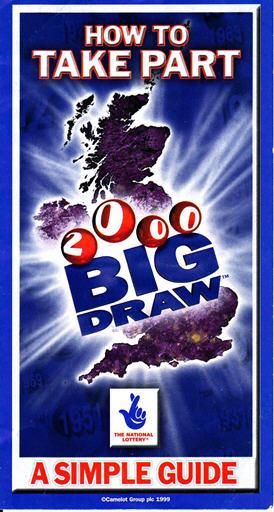

(© Camelot Group plc 1999).


Two games for the price of one
The first game, designated Game 1 and held before midnight, resembled the familiar National Lottery game, which we now call Lotto, except there were 100 numbers from the past century (between 1900 and 1999) on each board instead of the usual 49. Players could choose six numbers themselves or opt for a Lucky Dip.
As a game of chance framed in this way, there could be no guarantee that anyone would win the top prize, so what of Camelot’s stated aim regarding new millionaires?
Guaranteeing a fixed number of millionaires would demand a different approach. Holding a raffle as the second game (Game 2) would fulfil this objective. In effect, Camelot’s computer system would have to pick two years randomly from the previous millennium and the new one. i.e., 1000-1999 and 2000-2999.
How might that be achieved in practice without duplication? We shall investigate later how to emulate the raffle.
How to play
- Game 1 – Pick six years from 1900 to 1999, or select a Lucky Dip to play one board. The play slip had two boards. Was this inclusion a gentle nudge to encourage players to spend £10 rather than £5? Perhaps, yes?
- Game 2 – No action is required since the computer terminal will select two years automatically on your behalf.
Prize structure
| Match | Odds | Prizes (estimated)[3] |
|---|---|---|
| 5 years | 1:12,547,920 | £10,000,000 |
| 4 years + bonus year | 1:2,536,282 | £100,000 |
| 4 years | 1:54,544 | £2,000 |
| 3 years + bonus year | 1:27,272 | £1,500 |
| 3 years | 1:890 | £150 |
| 2 years + bonus year | 1:890 | £100 |
| 2 years | 1:40 | £40 |
| 1:36 overall |
| Match | Odds | Guaranteed Prize |
|---|---|---|
| 2 years | 1:1,000,000 | £1,000,000 |
Method adopted for Game 2
Let us consider how the scheme might work by emulating it with an Excel workbook[4]. In principle, the method applies to Game 2 of all Big Draws and Christmas Millionaire Makers.
Steps
There are several steps.
- We begin by preparing a block containing a list of one million ordered pairs, formed so that each year from the first millennium is paired with each year from the second millennium (1,000 years multiplied by 1,000 years). If we enclose each ordered pair in parentheses, the result is a list from (1000, 2000) up to (1999, 2999), without repetition or omission.
- Starting at the head of the list (1000, 2000), assign an index to the pair between 1 and 1,000,000 randomly. e.g. 894517.
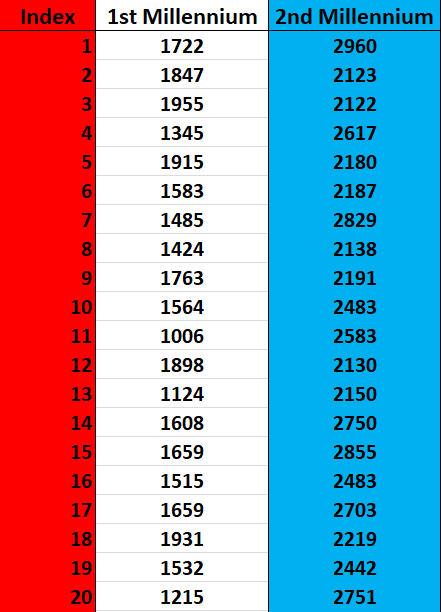
- Work down the list from top to bottom, assigning indices to all pairs while ensuring there are no duplicates. In other words, every index is unique – see the figure below. Some attempts to assign indices randomly will fail as they become used up as this task proceeds.
- Finally, sort the list by index in ascending order.
After completing these steps, we have built a functional block of one million unique pairs, fully indexed.

Random purchases
In our experiment, imagine that tickets for Big Draw 2000 have just gone on sale. Now suppose that the first customer buys two boards at a newsagent in Reading. The years (1722, 2960) and (1847, 2123) would appear on his ticket. A fraction of a second later let us suppose that another customer in Durham buys a single board. Her ticket would contain (1955, 2122).
After that, the system would continue to allocate ordered pairs to tickets as players make further purchases across the country, working its way down the list. Eventually, the block will become exhausted, and a new one will start. Although each block contains the same one million ordered pairs, the sequence is different, as shown by the figure below for a small part of block 2.
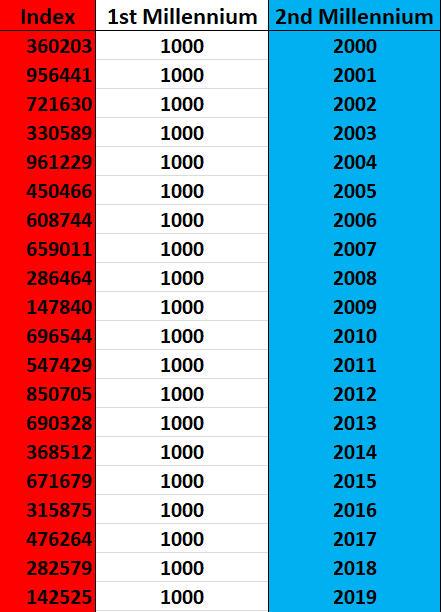

For instance, mirroring what happened earlier with block 1, the first player to buy two boards to open the second block (i.e. customer 1000001) would get (1688, 2114) and (1143, 2677), while the second player (i.e. customer 1000002) would receive (1188, 2072) to accompany his single board.
Guarantee assured
According to Camelot’s guarantee, there can indeed be only one winner per block with the action described above.
To meet its sales forecast of 25 new millionaires, Camelot would need to prepare at least 25 blocks in advance, and probably more for a margin of safety.
Results
Big Draw 2000
| #1 | #2 | #3 | #4 | #5 | Bonus | |
|---|---|---|---|---|---|---|
| Game 1 | 1986 | 1950 | 1918 | 1958 | 1901 | 1903 |
| Game 2 | 1575 | 2832 |
I bought one Lucky Dip. However, I cannot remember how many years I matched – certainly not enough to secure a prize. Unfortunately, I did not retain my ticket after the draw had taken place and therefore have no permanent record of my entry.
Sales of £80.6 million fell well short of the £125 million predicted, with 16,120,361 boards sold instead of 25 million! The draw seemed clunky and lacked the smooth professionalism we had come to expect; confusion abounded in the TV studio.
Furthermore, to compound the woes, no one won the jackpot. Luckily, the rules had allowed the prize to roll down to the tier below. It was an inauspicious start to an innovative new game that seemed promising at first sight. That was a shame, I think!
| Category of prize | Number of winners | Prize | Prize Pool | Prize Pool % |
|---|---|---|---|---|
| Match 5 (jackpot) | 0 | £0 | £0 | 0.0% |
| Match 4 plus bonus | 2 | £3,563,220 | £7,126,440 | 24.1% |
| Match 4 | 237 | £2,514 | £595,818 | 2.0% |
| Match 3 plus bonus | 319 | £2,815 | £897,985 | 3.0% |
| Match 3 | 14,859 | £184 | £2,734,056 | 9.2% |
| Match 2 plus bonus | 10,744 | £172 | £1,847,968 | 6.2% |
| Match 2 | 381,468 | £43 | £16,403,124 | 55.4% |
| Total: | 407,629 | £29,605,391 | 100.0% |
| Category of prize | Number of winners | Prize | Prize Pool |
|---|---|---|---|
| Match 2 | 16 | £1,000,000 | £16,000,000 |
Big Draw 2001
The National Lottery staged another New Year’s Day draw consisting of two games to herald the start of 2001, twenty minutes apart, shortly after midnight during the televised celebrations. They followed the pattern set in the previous year with identical prize tiers. Tickets went on sale from 1 December 2000 – one month later than the last year.
Players could choose five years taken from the last hundred years (1901 to 2000) or opt for a Lucky Dip in the first game if they wished. As before, the second game was automatic; the computer terminal chose years from two millennia – 1000 to 1999 and 2000 to 2999.
| #1 | #2 | #3 | #4 | #5 | Bonus | |
|---|---|---|---|---|---|---|
| Game 1 | 1909 | 1931 | 1982 | 1992 | 1920 | 1911 |
| Game 2 | 1620 | 2438 |
I bought one Lucky Dip and won nothing. Also, I did not keep my ticket.
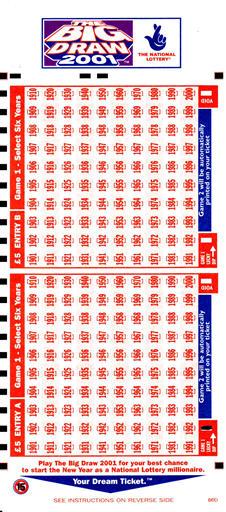
| Category of prize | Number of winners | Prize | Prize Pool | Prize Pool % |
|---|---|---|---|---|
| Match 5 (jackpot) | 0 | £0 | £0 | 0.0% |
| Match 4 plus bonus | 0 | £0 | £0 | 0.0% |
| Match 4 | 43 | £54,587 | £2,347,241 | 25.9% |
| Match 3 plus bonus | 103 | £2,650 | £272,950 | 3.0% |
| Match 3 | 3,212 | £260 | £835,120 | 9.2% |
| Match 2 plus bonus | 3,452 | £163 | £562,676 | 6.2% |
| Match 2 | 88,676 | £57 | £5,054,532 | 55.7% |
| Total: | 95,486 | £9,072,519 | 100.0% |
| Category of prize | Number of winners | Prize | Prize Pool |
|---|---|---|---|
| Match 2 | 5 | £1,000,000 | £5,000,000 |
After the disappointment of the year 2000, Camelot scaled back its sales projections to what they thought would be a more realistic figure of £80 million. However, even this estimate was too optimistic. Actual sales reached £24,739,425 with only 4,947,885 boards sold – 31% of their estimate.
Furthermore, there were no winners in the top two prize tiers, leaving 43 winners to receive a top prize of £54,587 each after rolling down the prize pools to the Match 4 years category. Disappointingly, there were no new millionaires in Game 1 this time! Showing grace, at least Camelot funded five millionaires in Game 2 despite selling less than 5 million boards.
Christmas Millionaire Maker 2001
To enter, I could have chosen six years between 1902 and 2001, but instead, I opted for a Lucky Dip. As you can see below, I failed to win a prize.
| #1 | #2 | #3 | #4 | #5 | Bonus | |
|---|---|---|---|---|---|---|
| Game 1 | 1923 | 1961 | 1965 | 1908 | 1999 | 1917 |
| Game 2 | 1986 | 2773 |
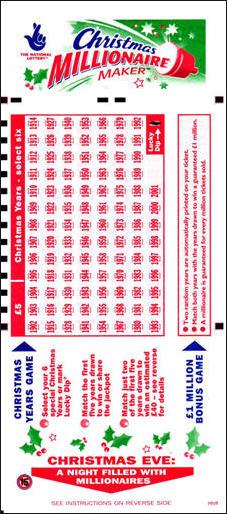

| Category of prize | Number of winners | Prize | Prize Pool | Prize Pool % |
|---|---|---|---|---|
| Match 5 (jackpot) | 0 | £0 | £0 | 0.0% |
| Match 4 plus bonus | 3 | £1,150,915 | £3,452,745 | 23.9% |
| Match 4 | 123 | £2,347 | £288,681 | 2.0% |
| Match 3 plus bonus | 258 | £1,686 | £434,988 | 3.0% |
| Match 3 | 8,387 | £158 | £1,325,146 | 9.2% |
| Match 2 plus bonus | 8,220 | £109 | £895,980 | 6.2% |
| Match 2 | 196,622 | £41 | £8,061,502 | 55.8% |
| Total: | 407,629 | £29,605,391 | 100.0% |
| Category of prize | Number of winners | Prize | Prize Pool |
|---|---|---|---|
| Match 2 | 7 | £1,000,000 | £7,000,000 |
Christmas Millionaire Maker 2002
I entered the Christmas Millionaire Maker draw in 2002 by buying a Lucky Dip. I matched only one year (1934), which did not qualify for a prize. This time, the years available for Game 1 lay between 1903 and 2002.
| #1 | #2 | #3 | #4 | #5 | Bonus | |
|---|---|---|---|---|---|---|
| Game 1 | 1915 | 1910 | 1934 | 1996 | 1929 | 1963 |
| Game 2 | 1668 | 2605 |

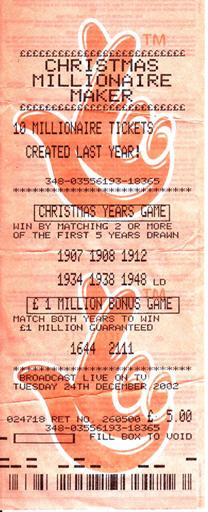
| Category of prize | Number of winners | Prize | Prize Pool | Prize Pool % |
|---|---|---|---|---|
| Match 5 (jackpot) | 0 | £0 | £0 | 0.0% |
| Match 4 plus bonus | 4 | £542,988 | £2,171,952 | 24.0% |
| Match 4 | 61 | £2,977 | £181,597 | 2.0% |
| Match 3 plus bonus | 197 | £1,389 | £273,633 | 3.0% |
| Match 3 | 4,156 | £201 | £835,356 | 9.2% |
| Match 2 plus bonus | 5,305 | £106 | £562,330 | 6.2% |
| Match 2 | 100,760 | £50 | £5,038,000 | 55.6% |
| Total: | 110,483 | £9,062,868 | 100.0% |
| Category of prize | Number of winners | Prize | Prize Pool |
|---|---|---|---|
| Match 2 | 5 | £1,000,000 | £5,000,000 |
Christmas Millionaire Maker 2003
The choice of years in Game 1 followed the existing pattern. On this occasion, the years fell between 1904 and 2003.
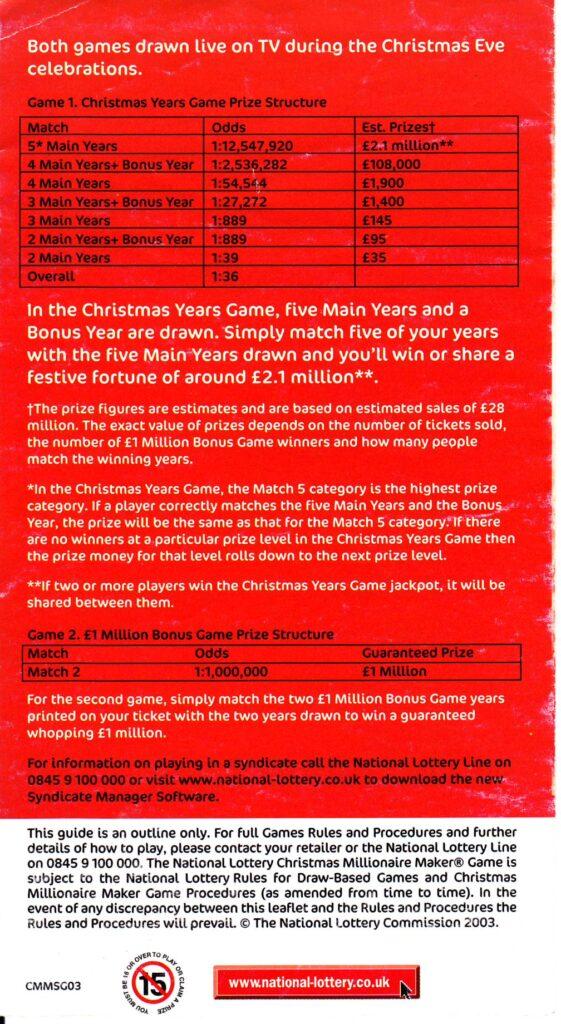
Promotional leaflet

© The National Lottery Commission 2003
| #1 | #2 | #3 | #4 | #5 | Bonus | |
|---|---|---|---|---|---|---|
| Game 1 | 1965 | 1962 | 1930 | 1991 | 1958 | 1934 |
| Game 2 | 1164 | 2569 |
I bought one Lucky Dip and won nothing. Unfortunately, once again, I did not retain my ticket after the draw had taken place and therefore have no permanent record of my entry.
At the time, I thought the entry price of £5 per board was too high. The general public seemed to have the same opinion since Camelot discontinued these lacklustre annual draws afterwards. They disappeared without fuss and have never been revived.
| Category of prize | Number of winners | Prize | Prize Pool | Prize Pool % |
|---|---|---|---|---|
| Match 5 (jackpot) | 0 | £0 | £0 | 0.0% |
| Match 4 plus bonus | 4 | £286,252 | £1,145,745 | 24.2% |
| Match 4 | 88 | £1,087 | £95,656 | 2.0% |
| Match 3 plus bonus | 251 | £575 | £144,325 | 3.0% |
| Match 3 | 4,579 | £96 | £439,584 | 9.3% |
| Match 2 plus bonus | 4,740 | £62 | £293,880 | 6.2% |
| Match 2 | 87,156 | £30 | £2,614,680 | 55.2% |
| Total: | 96,818 | £4,733,133 | 100.0% |
| Category of prize | Number of winners | Prize | Prize Pool |
|---|---|---|---|
| Match 2 | 4 | £1,000,000 | £4,000,000 |
Why did Camelot drop these games?
The National Lottery abandoned the annual Big Draws and Christmas Millionaire Maker draws after Christmas 2003. There has been no attempt to revive them since.
Possible reasons include the following:
- There was a high ticket price of £5, leading to lower ticket sales than expected. Over the first five years, the public had shown it was happy to pay £1 to play the original game and Thunderball but seemed reluctant to pay five times more for the Big Draws and Christmas Millionaire Makers.
- Picking six balls between 1 and 49 had become routine, but picking five years from a rolling century was less intuitive, even with Lucky Dips. i.e. Firstly 1900-1999, 1901-2000, 1902-2001, 1903-2002 and finally 1904-2003.
- The pattern of play had changed. Unusually, there were two components now – a familiar draw in which players could exercise their choice, followed by a raffle as a second game. In the latter, the computer system allocated two years automatically on behalf of the player, who had no control over the choice. Camelot’s guarantee to make a fixed number of millionaires in line with ticket sales dictated holding a raffle; there was no other easy way to fulfil their promise.
- The draws appeared awkward to stage and sometimes lacked the customary professionalism.
- The tables below show how prizes compared with the usual games. Big Draws and Christmas Millionaire-Makers conferred only a slight extra advantage for their higher cost.
- In many players’ minds, it would have been better to have stuck with the familiar weekly games and boosted their jackpots.
| Item | BD2000 | BD2001 | CMM2001 | CMM2002 | CMM2003 |
|---|---|---|---|---|---|
| Sales | £80,601,805 | £24,739,425 | £37,732,170 | £24,782,200 | £15,406,215 |
| Match 4+ | £3,563,220 | £0 | £1,150,915 | £542,988 | £286,252 |
| Match 4 | £2,514 | £54,587 | £2,347 | £2,977 | £1,087 |
| Match 3+ | £2,815 | £2,650 | £1,686 | £1,389 | £575 |
| Match 3 | £184 | £260 | £158 | £201 | £96 |
| Match 2+ | £172 | £163 | £109 | £106 | £62 |
| Match 2 | £43 | £57 | £41 | £50 | £30 |
| Game 2 winners | 16 | 5 | 7 | 5 | 4 |
| Item | 1 Jan 2000 | 30 Dec 2000 | 22 Dec 2001 | 24 Dec 2002 | 24 Dec 2003 |
|---|---|---|---|---|---|
| Sales | £47,803,587 | £49,205,792 | £46,525,030 | £25,398,927 | £25,467,565 |
| Match 6 | £1,170,389 | £3,379,718 | £1,483,169 | £1,108,476 | £1,839,979 |
| Match 5+ | £31,044 | £103,991 | £76,059 | £102,320 | £102,935 |
| Match 5 | £914 | £1,504 | £1,146 | £1,390 | £1,887 |
| Match 4 | £39 | £57 | £45 | £50 | £69 |
| Match 3 | £10 | £10 | £10 | £10 | £10 |
| Lotto Extra | – | £9,223,057 | £5,662,574 | £1,585,236 | £5,645,792 |
Notes
- [1] The COVID-19 pandemic muted New Year’s Day celebrations in 2021 as governments worldwide placed restrictions on gatherings to curtail the spread of the pandemic.
- [2] Countries like Fiji and New Zealand, close to the International Date Line in the Pacific Ocean, would be among the first to witness the change from 31 December 1999 to 1 January 2000 and planned accordingly. Also, major cities like Paris, London, and Sydney announced early plans for their celebrations.
The International Date Line is an imaginary line drawn on Earth’s surface in the Pacific Ocean from the North to the South Pole. It marks where a calendar day changes from one to the next. - [3] Prizes are based upon sales estimated at £125 million.
- [4] Using VBA code embedded in a Microsoft Excel macro-enabled workbook, I was able to construct a block of one million pairs of years taken from two millennia – see Appendix below.
I wrote three macros – FormIndex, SortByIndex and ClearIndex.
Appendix
Option Explicit

Public Const COL_A As Integer = 1
Public Const COL_B As Integer = 2
Public Const COL_C As Integer = 3
Public Const MILLION As Long = 1000000

Public Sub FormIndex()
    Const cstrRANGE As String = "A2:C1000001"
    Dim i As Long
    Dim j As Integer
    Dim k As Integer
    Dim n As Long
    Dim lngCount As Long
    Dim lngTries As Long
    Dim boolUsed(1 To MILLION) As Boolean
    Dim varData(1 To MILLION, COL_A To COL_C) As Variant
    Dim rngData As Range

    ' Compile a list of pairs of years in columns B and C
    ' taken from two millennia, (1000-1999) and (2000-2999),
    ' starting at row 2 to allow for a heading in the first row.

    ' There will be 1,000,000 rows of pairs in the list.

    Application.StatusBar = "Preparing a list of one million ordered pairs ..."

    Set rngData = shtBlock.Range(cstrRANGE)

    rngData.ClearContents

    ' Firstly, form the pairs

    n = 0

    For j = 1000 To 1999
        For k = 2000 To 2999
            n = n + 1
            varData(n, COL_B) = j
            varData(n, COL_C) = k
        Next k
    Next j

    ' Construct a unique index (between 1 and 1000000) for each row in the list
    ' of ordered pairs

    Application.StatusBar = "Adding an index at random to the list of pairs ..."

    For i = 1 To MILLION
        boolUsed(i) = False
    Next i

    n = 0                           ' reset the counter
    lngTries = 0

    Randomize                       ' seed the random number generator

    Do
        i = WorksheetFunction.RandBetween(1, MILLION)

        If boolUsed(i) Then
            lngTries = lngTries + 1     ' count the attempts that failed
        Else
            n = n + 1                   ' store only if unused
            boolUsed(i) = True
            varData(n, COL_A) = i
        End If
    Loop Until n >= MILLION

    lngCount = 0                        ' consistency check for all done

    For i = 1 To MILLION
        If boolUsed(i) Then lngCount = lngCount + 1
    Next i

    rngData = varData

    MsgBox "Random index added to " & FormatNumber(lngCount, 0, GroupDigits:=vbUseDefault) & _
            " pairs after " & FormatNumber(lngTries, 0, GroupDigits:=vbUseDefault) & _
            " tries that failed.", vbOKOnly, "Pairs of years from two millennia"
    Application.StatusBar = False
    Set rngData = Nothing
End Sub

Public Sub SortByIndex()
    Const cstrRANGE As String = "A1:C1000001"

    Application.StatusBar = "Sorting by increasing index ..."

    With shtBlock.Sort
        With .SortFields
            .Clear
            .Add Key:=Range("A1:A1000001"), SortOn:=xlSortOnValues, _
                Order:=xlAscending, DataOption:=xlSortNormal
        End With

        .SetRange Range(cstrRANGE)
        .Header = xlYes
        .MatchCase = False
        .Orientation = xlTopToBottom
        .SortMethod = xlPinYin
        .Apply
    End With

    MsgBox "Sorted by index!", vbOKOnly, "Sorting pairs of years from two millennia"
    Application.StatusBar = False
End Sub

Public Sub ClearIndex()
    Const cstrRANGE As String = "A2:C1000001"
    Dim rngData As Range

    ' Clear the list of one million pairs and their indices

    Set rngData = shtBlock.Range(cstrRANGE)

    rngData.ClearContents

    Set rngData = Nothing
End Sub
Revision date: 24 July 2023
2 thoughts on “The Millennium and the Big Draw 2000”
For a future Lottery related Blog, you should talk about the other draw games to like Thunderball and EuroMillions as well as add-ons like Lotto Extra when that was around.
Thank you for your comment. I intend to do so fairly soon.
There is some limited discussion on the following pages already.
However, over the next few months I shall enlarge up on other games in the National Lottery portfolio, including Lotto Extra, Thunderball, Dream Number, Lotto Plus 5, and Set For Life.
Please watch this space, and thank you for visiting https://coulditbeyou.co.uk/