Types of Lottery
A lottery is a game of chance, not skill. Many players buy tickets to participate, but only some, a tiny minority, win prizes.

Courtesy of Alamy – G40WG9
Essentially, there are six types.
- Raffle
- Standard numbers game
- Genoese format
- Bingo
- Keno
- Football pools
A brief description follows with some modern examples, where appropriate.
Table of contents
Estimated reading time: 29 minutes
Raffles
Simple Raffle
It is easy to conduct simple raffles and tombolas in the United Kingdom and elsewhere using books of cloakroom tickets. The draws take place during the events. e.g. at village fêtes and coffee mornings.
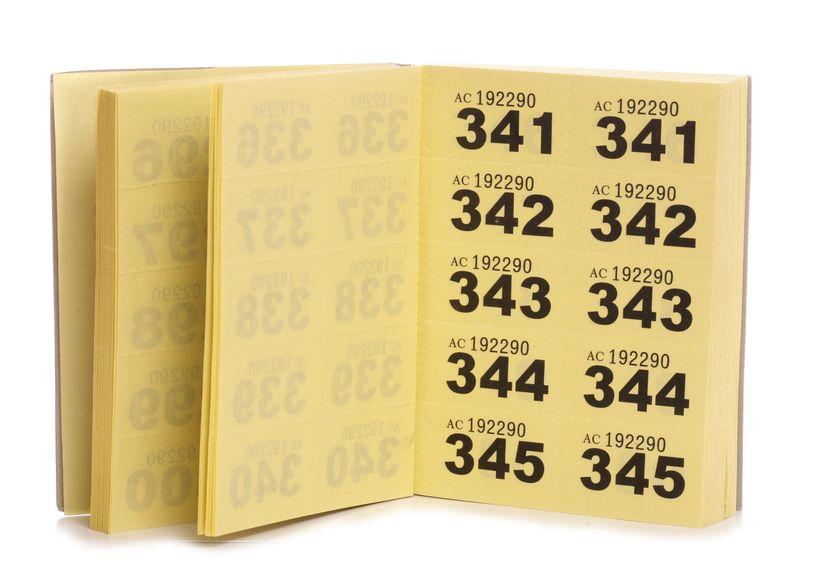
How a raffle works
- Books of cloakroom tickets contain pages bearing pairs of numbers (e.g. 1 to 1000) printed on pastel-coloured paper.
- Each number appears twice across the width of the page.
- Perforations on the page allow tickets to be separated from each other easily.
- An identification number marks all tickets in a book. The stamp prevents disputes and discourages cheating (e.g. AC 192290).
- Each ticket bought has the same chance of winning a prize.
- Typical prizes are bottles of whisky, brandy, perfume, and boxes of chocolates, each with a unique number attached. (e.g. 345 yellow). Often, local businesses donate these prizes.
- Upon sale, the vendor tears off the number to the right and gives the buyer the ticket, leaving the counterfoil bearing the same number to the left in the book.
- Where the price is low (e.g. 10p or 20p), players often buy whole pages sold as strips (e.g. 341-345).
- Once the raffle is closed to new players, the organisers separate the counterfoils from their books and place them in a drum.
- Then, an impartial person withdraws counterfoils, one at a time, usually after spinning the drum, allocating the first, second and third prizes, etc., to the winners. Whoever holds the ticket corresponding to the counterfoil drawn wins the current prize. The process continues until all prizes have been won.
- For this type of raffle, winners need to attend the draw. Someone will announce the winning numbers, and it is up to the players to respond and collect their prizes.
Tombolas
Tombolas are closely related to raffles but tend to have lower-value prizes. They operate differently, although there are similarities, and they use similar equipment.

Courtesy: Kullez from Hjärup, Sweden, CC BY 2.0, via Wikimedia Commons.
.jpg)
- The drum is filled with all counterfoils before the draw begins.
- Players are present during a draw and actively participate in the process.
- It is common practice in tombolas to allocate numbers ending in 0 or 5 to prizes, with all others being spare. e.g. 145 might relate to a bottle of premium malt whisky and 500 to a box of Belgian chocolates.
- After paying the appropriate fee to have a go, a player will place their hand into a drum spun briefly to jumble its contents and withdraw a ticket without looking or hesitating, repeating the action according to the number of goes bought. The price per ticket is usually a modest sum. e.g. 10p or 20p.
- Players know within seconds whether they have won a prize. Such conduct provides immediate gratification to those unlikely to stay for the whole event. e.g. show or fête. If lucky, you could come away with a bottle of malt whisky for as little as 10p under favourable circumstances.
More elaborate raffles
The scheme for simple raffles above works well for small prizes at village fêtes and other similar events. However, it is wholly inadequate for rewards with a higher value, such as cars and foreign holidays, which need a higher volume of sales to be viable and practicable.
More elaborate raffles with higher prizes work differently. Anonymous cloakroom tickets will not work. Instead, they need customised pre-printed stationery to sell well before the draw date, giving vendors enough time to sell sufficient tickets to make the raffle worthwhile for the cause it supports.
Buyers of tickets must supply their names and addresses on the counterfoils to enable the promoter to contact the winners, comply with the law, mitigate against fraud, instil confidence and satisfy customers. There are other legal requirements too.
The basic structure of a raffle ticket

A raffle ticket has at least two parts, separated by a perforation – one the buyer retains and a counterfoil which will be returned to the promoter for inclusion in the draw.
Each ticket is numbered uniquely and states the purpose of the draw, the cost per ticket, and the list of prizes. Also included is the draw’s date and where it will be held. The buyer writes their name and address on the counterfoil.
Usually, batches of tickets are stapled together in groups, which is convenient for sale. However, modern books use glue rather than staples; a second perforation facilitates the separation of the counterfoils.
Recently, I bought a book of twelve raffle tickets in the CAFOD Spring Raffle 2023.
| Location on ticket | Component | Details |
|---|---|---|
| Front | 1st Prize | £7,000 |
| Front | 2nd Prize | £2,000 |
| Front | 3rd Prize | £1,000 |
| Front | Five Runner-up Prizes | £100 |
| Front | Closing Date | 5 May 2023 |
| Front | Draw Date | 19 May 2023 |
| Front | Ticket price | £1 |
| Back | Responsible person | Damian Conlin |
| Back | Organisation | CAFOD, Romero House, 55 Westminster Bridge Road, London SE1 7JB |
| Back | Gambling Commission Reference No. | 042347 |
Millionaire Maker
The Millionaire Maker game is a sophisticated example of a raffle that works in conjunction with Euromillions. Camelot allocates Millionaire Maker ticket numbers on your behalf automatically – one for each Euromillions board that you buy; you cannot choose your own.
Tickets are available nationally throughout the UK via the Internet using a National Lottery account or a retailer’s terminal. Draws take place twice a week on Tuesdays and Fridays. Due to its widespread appeal and long reach, the National Lottery can guarantee at least one winner of £1 million for each draw[1], which would be very difficult for any paper-based scheme.
Millionaire Maker began as the Millionaire Raffle in November 2009, when Camelot raised the price of a Euromillions board from £1.50 to £2. Camelot changed its name to Millionaire Maker, effective from 24 October 2014. The terms Millionaire Maker and Millionaire Raffle are synonymous.
Euromillions had a slow start here. Perhaps the public saw no need for a seemingly foreign game, while Lotto Extra[2] could provide larger jackpots. However, Lotto Extra ended on 8 July 2006.
The introduction of the Millionaire Raffle changed the fortunes of Euromillions in the UK. Coincidentally, UK players won some spectacular jackpots between 2009 and 2011. Since then, Euromillions has attracted a significant following here. Camelot uses Euromillions to promote the National Lottery consistently by offering more raffle prizes now and again.
The current cost of a Euromillions board in the Eurozone is €2.50. In Switzerland, each board costs CHF3.5. Players in the United Kingdom pay £2.50, but the price includes an automatic entry into the Millionaire Maker game.
Premium Bonds
Premium Bonds are another example of a raffle. The British Government introduced them nearly seventy years ago, in 1956. There are monthly draws, and the interest accrued from the prize fund pays for the prize money. Unlike most other raffles, in which the stake is lost, the bond holder’s capital remains intact and available for refund in full by request, after which the bonds become ineligible for future monthly draws.
Until 2015, you could buy Premium Bonds at your local post office, but that route was withdrawn.
Now, you can buy Premium Bonds from NS&I:
- Online through the website
- By telephone
- Apply by post
Read: Premium Bonds for more information.
A brief history of Premium Bonds
A national lottery took a step closer in Britain when the Chancellor of the Exchequer, Harold Macmillan, presented his Budget to Parliament in 1956. He announced that Premium Savings Bonds would be sold to the general public. Prizes would be free of tax.
There was much opposition. In a House of Commons debate, Harold Wilson MP (later Labour Prime Minister) likened the scheme to a “squalid raffle“.
Premium bonds were not new; the French had used them effectively to finance large projects such as the Suez Canal. Some thought they could be used in Britain to repair the damage to national finances caused by the Great War[3] (1914-18).
National Savings issued the bonds, priced at £1 each, on behalf of the British government in 1956. Each bond has a unique serial number[4]. The Lord Mayor of London bought the first in a ceremony outside the Royal Exchange in the City of London when they went on sale in November 1956. The British public bought £5 million of Premium Bonds on the first day of sale.
Initially, you could buy bonds singly or in blocks, subject to a maximum holding of £500. However, the minimum purchase is now £25, and the maximum holding is £50,000.
In buying bonds, holders lend money to the government cheaply. For its part, the government pays interest into a prize fund, which is used to support a monthly draw with a tiered prize structure to attract investors. Winners are notified.
| Winners | Prize | Pool | Prize fund % |
|---|---|---|---|
| 2[5] | £1,000,000 | £2,000,000 | 10% |
| 62 | £100,000 | £6,200,000 | |
| 125 | £50,000 | £6,250,000 | |
| 249 | £25,000 | £6,225,000 | |
| 622 | £10,000 | £6,220,000 | |
| 1,246 | £5,000 | £6,230,000 | |
| 13,248 | £1,000 | £13,248,000 | 10% |
| 39,744 | £500 | £19,872,000 | |
| 1,409,059 | £100 | £140,905,900 | 80% |
| 1,409,059 | £50 | £70,452,950 | |
| 2,145,328 | £25 | £53,633,200 | |
| Total: 5,018,744 | £331,237,050 | 100% | |
Facts about Premium Bonds
- It took ERNIE sixteen minutes to generate the first winning number 1FK341150[6] on 1 June 1957. The draw finished on 3 June after 23,142 prizes.
- By May 2022, ERNIE had paid 562 million prizes worth £22.9 billion since 1957.
- In April 2023, the total had risen to 616 million prizes worth £25.3 billion. That month, NS&I paid out £331,237,050 in prize money; there were 5,018,744 prizes with 120,449,834,442 eligible bonds (1 in 24,000).
- Twenty-two million out of 67 million people own Premium Bonds totalling £120 billion – approximately one-third of the UK population. Thousands of prizes are won each month.
- National Savings introduced a maximum prize of £1 million in April 1994 to compete with National Lottery. The winning bond was 29JZ644125. Since 2009, the minimum prize is £25.
- Bonds become eligible for entry into the prize draws after a short qualifying period and remain eligible until the holder withdraws them or dies. In the latter case, bonds are still valid for up to a year after the holder’s death.
- There is no time limit to claim a prize, and each bond has the same chance of winning, regardless of age or where it was bought – about 1 in 24,000 from October 2009.
- Initially, bond numbers contained eight alphanumeric characters. e.g. AN842130, issued in November 1956. The number grew to 9, 10 and then 11 over the years as the public bought more and more bonds, thus outstripping the generating capacity of the equipment used. Also, the draws took longer to make, requiring faster processing.
ERNIE
A dedicated machine, code-named ERNIE, picks the numbers of the prize-winning bonds randomly.
Premium Bonds have been a resounding success since their introduction and still attract many investors. ERNIE caught the attention of the public early on and became anthropomorphised[7].
Successive generations of ERNIE have been able to generate prize-winning numbers more quickly to keep up with the rising demand for Premium Bonds over the years.
| Model | In Use | Draw Speed (bond/hour) | Time taken per draw | Numbers drawn (total) | Total Prizes |
|---|---|---|---|---|---|
| Original | Jun 1957 – Jan 1973 | 2,000 | 3-10 day | 8,067,575 | £303,779,900 |
| ERNIE 2 | Feb 1973 – Aug 1988 | 65,000 | < 1 day | 22,740,704 | £1,494,420,100 |
| ERNIE 3 | Sep 1988 – Mar 2004 | 330,000 | 6 hour | 77,885,566 | £5,113,645,250 |
| ERNIE 4 | Apr 2004 – Feb 2019 | 1,000,000 | 2.5 hour | 322,002,740 | £12,205,221,800 |
| ERNIE 5 | Mar 2019 – Apr 2023 | ~15 million | 15 min | ~ 616 billion | ~ £25.3 billion |
| Date | Bonds (billions) |
|---|---|
| Jun 1957 | 0.049 |
| Sep 1988 | 2.2 |
| Nov 2006 | 32.3 |
| Jun 2017 | 64.1 |
| May 2022 | 117.8 |
| Mar 2023 | 120.1 |
| Apr 2023 | 120.4 |
Signal noise in glass tubes filled with neon gas generated random numbers in the original ERNIE. Later versions used thermal noise in transistors, but now ERNIE 5 uses an alternative technology with light quanta to generate random numbers.
ERNIE undergoes strict tests regularly by the Government Actuary’s Department to ensure that its output has no discernable set pattern and is genuinely random. Successive generations of ERNIE have always succeeded in these tests.
Winning numbers generated by ERNIE are matched later with eligible bondholders to ensure no bonds can be left out of the draw.
The Money Saving Expert website, conceived by the broadcaster Martin Lewis, has a calculator to help you predict how likely you are to win.
Alternative form of raffle
The raffle has an alternative method of play, which can be very time-consuming if there are many prizes and tickets.
Numbers are allocated to prizes secretly before the draw begins, implying that they are unknown to vendors and buyers alike.
As the draw proceeds, tickets are drawn and compared with the numbers assigned to the prizes earlier. The process continues until all prizes have been won. Winners receive their prizes, but many tickets are without reward.
Early lotteries worked like this, which made the draws lengthy processes, spanning several days.
Read: Early lotteries in England – a national love affair for more information.
Modern scratch cards work like this too. There follows a long, drawn-out process consisting of many discrete steps rather than a single focussed event.
Events occur nationwide in shops and newsagents as people purchase scratch cards and scrape off the thin metallic layer to reveal whether they have won anything.
Players can buy scratch cards while the draw remains open. In most other forms, money changes hands only before a draw begins, not while it is underway, which is a significant difference.
Standard Numbers Game
Players choose numbers with a fixed number of digits or receive them from the promoter.
In a 5-digit game, valid numbers range between 00000 and 99999. Altogether, there are 100,000 numbers consisting of 5 digits.
Ten balls numbered 0, 1, 2, 3, 4, 5, 6, 7, 8 and 9 jumble in a container. One ball removed blindly forms the first digit of the result.
The process repeats until all the required digits have been drawn – five in this example.
The winning ticket bears 19069 if balls 1, 9, 0, 6 and 9 appear in that order. Therefore, the ticket holder with the number 19069 wins the prize.
The portfolio of games provided by the National Lottery used to include the Dream Number[8]. This game helped to fund the London 2012 Olympic and Paralympic Games.
Any player buying a Lotto board could choose to buy an optional Dream Number board by paying a supplement if required. A Dream Number consisted of 7 digits. e.g. 8230839.
In making this choice, a player could accept the Dream Number pre-printed on the playslip or let Camelot choose an alternative randomly; you could not select your Dream Number yourself.

(Playslips © Camelot, The National Lottery)
Genoese Format
As the name suggests, this format originated in the Italian city of Genoa during the Middle Ages.
Importantly, it offers the prospect of large jackpots, which are more challenging to achieve with the other types of lottery.
With some local variations, it forms the basis of most modern state lotteries, including the game of Lotto in the UK.
Commonly, players select six numbers from 49. There are several tiers of prizes. Currently, players of Lotto in the UK choose six numbers from 59 instead of 49 in the original game.
Unsurprisingly, this website focuses primarily on the Genoese format.
Bingo
Background
Many scholars believe that Bingo originated in Italy during the fifteenth century and spread to Great Britain through Western Europe.
Players receive a set of numbers at the start of a game.
Typically, these numbers are printed on a card. Players tick off the numbers as they are called, and the first person to tick off all their numbers wins the game.
Bingo plays with 90 balls in the UK, numbered consecutively from 1 to 90; other variations exist elsewhere.
A bingo ticket (or card) consists of a grid of 27 cells arranged in 3 rows of 9 columns. In each row, only five columns contain numbers; the others are blank. Consequently, each column contains 1, 2 or 3 numbers – see the example below[9].
You can see from the figure that printing six strips[10] on a bingo card allows all 90 numbers to appear once.

In practice
Operators can draw numbers in several ways with different degrees of sophistication. The simplest involves the removal of tokens blindly from a bag or cage; at the other end of the scale lies electronic random number generation.

Prize categories
There are usually four prize categories, reflecting the increasing degree of difficulty. You must match the following to win.
- Corners – numbers on the left and right of the top and bottom rows; that’s four numbers.
- Line – a complete row of five numbers.
- Two Lines – matching two rows on the same ticket (i.e. 10 numbers).
- Full House – all numbers on the ticket (i.e. 15 numbers).
The category of play should be clear from the start. e.g. a complete line.
Evolution
There have been many attempts to modernise the game of bingo. In the early 1960s, seaside stalls promoting bingo games were commonplace. They made use of illuminated consoles that mimicked the design of bingo tickets. Little plastic shutters, moving sideways, enabled players to mark off easily which numbers had been called. Numbers were drawn by catching lightweight balls agitated by blasts of compressed air or jumbled mechanically by rotating them in a drum.
Bingo has adapted well to the internet, widening its circle of players considerably.
Keno
Keno originated in China. During the 19th century, many Chinese emigrated from China, crossing the Pacific Ocean to the west coast of the USA to build transcontinental railroads. They brought the game with them. Initially, players used to mark their choices on sheets of 80 Chinese characters, but later these characters were replaced by the numbers 1 to 80 after Keno became accepted in the Western hemisphere.
Keno is played in casinos, and many state lotteries in the USA offer Keno. It has been adapted successfully to be played by electronic means.
Keno does not concern us much. It is a popular game with many variations, many of which involve picking 20 numbers from 80-numbered lightweight balls mixed by air currents in a machine. There are prizes for players who have matched several numbers drawn, sometimes even for no matches. Draws take place at short, regular intervals.
Bingo versus Keno
Although there are some similarities superficially between Bingo and Keno, they are different games.
- Bingo players do not choose their numbers; they use pre-printed sheets valid during a session.
- Keno players select by marking them on a card and registering for the next game.
Football pools
From our discussion, prizes large enough to change people’s lives can only come from a consistently high volume of sales, week in, week out, year in, year out.
Small, local raffles can never attain this goal. Any enterprise must be on a large scale and robust to succeed. i.e. it must be national and operate regularly.
In the twentieth century, until the advent of Premium Bonds in 1956, only organised betting on the results of football matches played on Saturdays came close. Indeed, football pools have played a significant role in the life of the nation.
Punters bet on the outcomes of football matches. The money from bets formed a pool, enabling prizes to be paid after deducting management expenses of less than 10%, hence the name of Football Pools[11].
Background
The football pools may have originated in Sweden but started in Britain in Birmingham.
Punters completed their forecasts on coupons which they submitted to the pools organisers with a small cash fee to cover their stakes.
By the end of the 1920s, several companies had set up to exploit the concept commercially. In the 1930s, the two market leaders, Littlewoods and Vernons, built offices in Liverpool to process football pools coupons. They employed many staff; the business was labour-intensive on a week-to-week basis.
Impact of the Great War and the Great Depression
The period coincided with a resurgence in gambling as many sought quick relief from their financial woes.
Coming soon after the Great War of 1914-18, the General Strike in 1926, the Stock Market Crash of 1929 and the long period of mass unemployment that followed left indelible impressions on the psyche of the British working class. The times were hard. Football pools and greyhound racing became very popular. However, the football pools were the more socially acceptable, and the prizes were usually higher.
In 1938, there were reports that 10 million Britons filled in coupons regularly and that sub-postmasters were seeking extra pay to handle the large volume of mail generated by the football pools.
The Second World War
The Government suspended football pools at the beginning of the Second World War to conserve paper but relented in the interests of public morale. The pools companies collaborated to operate the Unity Pools until 1946, printing the entry coupons in national newspapers.
Post-war
After the war, the most popular pool was the Penny Points Pool, with prizes in the region of £30,000 for forecasting 13 out of 14 matches correctly. However, soon after its introduction in the 1946/7 season, the Treble Chance[12] pool became more popular still than Penny Points.
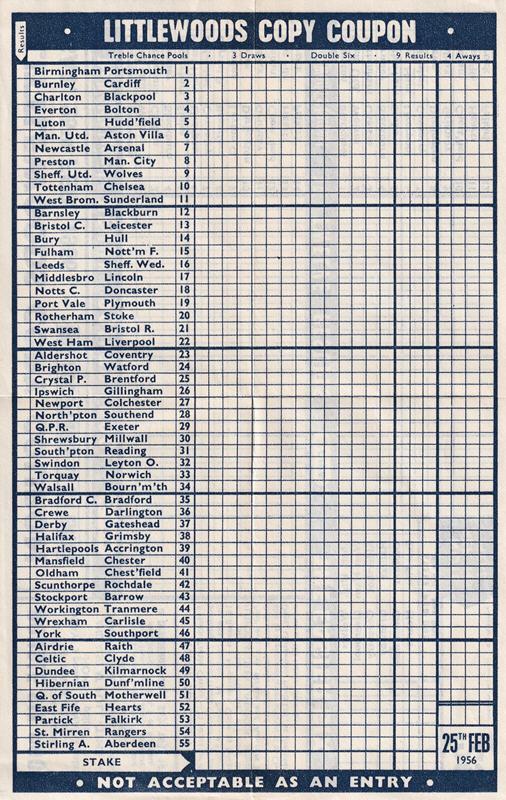

(from my personal archive)
The Government introduced Betting Duty of 10% in 1948; two years later, it rose to 30%. Furthermore, the Government enacted legislation that explicitly applied to football pools in 1954, incorporating it into the Betting, Gaming and Lotteries Act 1963.
Innovations
Acting through the Pools Promoters Association (PPA), the major pools companies, Littlewoods, Vernons and Zetters, made several innovations over the years in response to changes in circumstances.
The innovations included:
- Continuous operation – achieved by introducing a summer season based on matches played in Australia.
- The Pools Panel to adjudicate the results of postponed or cancelled matches. The panel was set up in response to a very harsh winter in the 1962/3 season, which caused severe disruption to play over several weeks.
- A collector service to distribute and collect coupons from players, which proved invaluable during the postal strike of 1971. It reduced postal costs substantially and meant that players could make cash payments to the collectors. They no longer needed to buy postal orders to submit their entries, which incurred an extra charge.
- Refinement of the points system in 1969.
The increasing use of defensive tactics adopted by teams in the 1960s led to a higher frequency of goal-less draws, which had the effect of depressing dividends, and reducing interest in the pools. It became necessary to distinguish between draws in which goals had been scored and those without goals.
The revised scheme awarded three points for a score draw and two for a no-score draw; home or away wins received 1½ points. Changing the points system thus rejuvenated the business with the return of higher and more frequent dividends. - They introduced computerised systems to streamline their operations.
A winning formula
Undoubtedly, the pools companies had hit upon a winning formula with the Treble Chance, which attracted many players.
By offering the public a legitimate means of winning large sums of money weekly, the football pools business thrived for over seventy years. Doing the Pools became the regular pastime of millions and a national institution.
Aware of what had happened earlier on the Continent, the football pools companies were worried about the consequences of giving the British public easy access to lotteries, indigenous or foreign, when the European Single Market began in 1993.
They feared that customers would desert the pools en masse.
Buying a lottery ticket entailed picking a few numbers, a task easier than filling in a football coupon. This, on its own, might offer a big enough incentive to encourage a large number of players, which in turn would lead to noticeably large jackpots, detracting further from the pools.
Nemesis
These fears turned out to be well-founded. In 1994, the annual turnover of the football pools was almost one billion pounds. Then, the most significant promoter, Littlewoods, received about 8 million entries per week.
Seven years later, turnover had plummeted to £167 million, with Littlewoods receiving 1.4 million weekly entries. However, reducing the level of tax to 17½% did not stem the decline.
Impact of the National Lottery
- The National Lottery decimated the business of the football pools suddenly.
- Unfortunately for the pools, the new game had attracted players in their millions regularly, capturing their minds and opening their wallets. In its first year, the sale of tickets for the Online game[13] exceeded £3 billion.
- The National Lottery was easy to understand, simple to play and accessible through a familiar network of retailers on the high street. e.g. newagents, supermarkets and post offices.
- Wholesale computerisation was pivotal to the National Lottery’s success; players filled in play slips which specialised electronic point-of-sale terminals linked to a remote computer system via telephone lines could read reliably and print tickets in seconds.
- Only retailers took cash, a routine activity for them; on the other hand, the operator, Camelot, could avoid handling millions of coins and banknotes regularly and use electronic banking.
- Sophisticated computer software managed and recorded millions of bets and identified the winners, enabling retailers to pay out minor prizes later.
- The National Lottery could work out very quickly the size and number of prizes to pay. This position contrasts sharply with the pools companies; they had to process vast numbers of coupons laboriously before knowing the true extent of their financial liabilities.
- Unlike the pools, there was no need for a small army of back office staff checking and validating coupons; automation took care of the significant processes, reducing errors considerably, with less of a staffing overhead.


This leaflet (© Camelot Group Plc. The National Lottery, PO Box 287, Watford WD1 8TT) forms part of my collection of lottery memorabilia.
- Thanks to a vigorous, colourful, pervasive and persuasive promotional marketing campaign, televised draws and jackpots that exceeded the maximum of £2 million offered by the pools regularly, the Lottery had a freshness and vitality that the pools no longer had.
- In comparison, they looked drab, stale and old-fashioned. Their business model was shot to ribbons and had had its day.
Outcome
So, what happened to the pools companies, which had once held such sway?
The answer is that they ceased to be mainstream as far as the gambling public was concerned. Vernons Pools was taken over in 1988 and eventually became part of Ladbrokes. The Littlewoods Organisation sold its subsidiary, Littlewoods Pools, to Sportech plc in September 2009. Two years later, Sportech acquired the football pools business of Zetters. An independent reign ended after spanning nearly three-quarters of a century.
After acquiring Vernons in 2007, Sportech rebranded the football pools as The New Football Pools, now shortened to The Football Pools.
A thriving business
Meanwhile, the National Lottery lives on with an impressive track record and goes from strength to strength. There will be a new operator, Allwyn, in 2024 at the start of the fourth licence[14].
Since 1994, some people have suddenly become wealthier than they ever imagined[15]. The National Lottery continues to distribute wealth and supports Good Causes generously. It is a Great British success story!
Former Prime Minister John Major has every right to be proud of the project[16] he championed in 1993.
Notes
- [1] A raffle guarantees that prizes will be won, unlike games like Lotto, where there can sometimes be no jackpot winner. Such a case arises when no player has chosen the particular set of six balls drawn, producing a rollover.
See how Camelot can make the guarantee by reading the discussion about the Big and Christmas Millionaire Maker Draws, which are now defunct. - [2] Lotto Extra was a jackpot-only game between 15 November 2000 and 8 July 2006, running alongside Lotto. To play Lotto Extra, you had to buy a Lotto board and pay a supplement of £1.
- [3] Not even the enormous financial burden of the First World War could persuade the government to change the law relating to lotteries. In 1917, a House of Commons Select Committee considered Premium Bonds to raise finance. However, the antipathy towards games of chance was so great that the idea was dropped in the belief that Parliament would not accept them.
- [4] Originally, bond numbers consisted of 8 alphanumeric digits. Later, the size increased to 9 alphanumeric digits, then 10 to meet rising demand; now, it is 11.
- [5] The winning bond numbers were 263TZ340702 (Somerset) and 503VL397852 (Croydon).
- [6] The winning Premium Bond belonged to an investor in Cumbria, who won the top prize of £1,000 then.
- [7] Incredibly, he receives letters and cards from the public!
- [8] Dream Number helped to fund the London 2012 Olympic and Paralympic Games; it was available only between 15 July 2006 and 9 February 2011.
There were seven prize tiers – ranging from £2 to £500,000. Players had to match all the digits of a 7-digit number one for one in the correct order to win the top prize of £500,000.
Dream Number partnered with Lotto, which meant you could not buy a Dream Number ticket separately.
Playing Dream Number was optional, but you could not choose your own if you wanted to play the game. Either you had to accept the number pre-printed on the play slip or have one generated for you randomly by Lucky Dip.
Furthermore, although there were seven boards with labels A to G, only one Dream Number was available per play slip. You can see this clearly in the image of the three play slips above. Notice that the three pre-printed Dream Numbers available here are: 4633075, 7403273 and 3962573. - [9] Some promoters fill their columns differently to make it easier and quicker for players to spot the numbers called out on the card before them – grouped in units, tens, twenties, thirties, …, seventies and eighties. However, such a grouping causes an uneven split among the 90 numbers, placing 1 to 9 in column 1 and 80 to 90 in column 9; the other columns are populated from a list of ten numbers each. i.e. (1-9, 10-19, 20-29, 30-39, 40-49, 50-59, 60-69, 70-79 and 80-90.
- [10] 6 tickets × 15 numbers per ticket = 90 numbers in total.
- [11] Legislation treats football pools as lotteries.
- [12] The Treble Chance pool worked in the following way. Each week of the football season, the promoter (e.g. Littlewoods) printed a coupon containing a list of approximately 50 fixtures that were scheduled to be played in the football league.
To take part, a player had to choose the eight fixtures that were most likely to achieve the most points, in their opinion, by marking the selection with a series of X‘s in a vertical column against the chosen fixtures. To qualify, the promoter must receive the entry coupon with the stake before the matches take place.
Multiple entries were allowed, and they became standard practice since each line cost no more than a fraction of a penny. Subsequently, the pool promoters published several plans called perms, which allowed a player to submit large numbers of lines implicitly. e.g. The 8 from 10 perm consisted of 45 lines.
There were 3 points awarded for a drawn game, 2 points for an away win and 1 point for a win by the home team. The aim was to gain the maximum number of points from the eight games chosen.
After deducting legitimate expenses, tax and the operator’s profit from the total money staked, the prize pool was divided into three smaller pools initially, not necessarily of equal value. One was destined for winners having 24 points, another for winners with 23 points and finally, a third for winners with 22 points. Each pool was divided according to the number of winners in each category, and dividends were paid accordingly. Later, this was extended to five dividends.
Prizes in the first dividend varied weekly, depending on how many drawn matches appeared on the coupon. In weeks when there were few draws and few winners, the first dividend prizes were spectacular, attracting more players hoping to benefit in the future. - [13] This game is known now as Lotto.
- [14] Camelot has held the licence to operate the franchise since 1994. It began as a company owned by a consortium of shareholders, which included Cadbury Schweppes, De la Rue, Racal Electronics, International Computers Ltd and the GTech Corporation.
In 2010, the Ontario Teachers’ Pension Plan, an independent organisation based in Canada, acquired all the shares, making Camelot a private limited company owned by a single shareholder.
Camelot held three licences from 1994, 2001 and 2007. Its third licence expires in February 2024.
Allwyn AG acquired Camelot’s UK operations in February 2023 from the Ontario Teachers’ Pension Plan. Allwyn UK will take over the operation of the UK National Lottery in February 2024, when the fourth licence begins. - [15] The lottery enterprise has produced spectacular results in 25 years. According to Camelot, between November 1994 and September 2019, it raised £43 billion for Good Causes, paid out £56 billion in prizes and created 6,100 millionaires – benevolence on a large scale. This performance is impressive by any standard.
- [16] Under Prime Minister John Major, the Conservative government established the Millennium Commission in the 1990s to celebrate the start of the new millennium. i.e. the year 2000.
The Commission would pay for celebrations, commemorative buildings, and environmental and community projects. A national lottery, unseen in Britain since 1826, would raise funds needed once it had become operational in 1994.
One proposal was to build a centrepiece to showcase Britain in the 21st century. After considering Birmingham, Derby, and London, the Commission settled on the Greenwich peninsula to locate its dome-shaped building.
Read: The Millennium Dome for more information.
The National Lottery would support Good Causes; its foundation rested on the principle of additionality. Initially, the Good Causes were: Arts, Charities, Heritage, Millennium Projects and Sports.
According to the Principle of Additionality, money raised by the National Lottery should be in addition to general taxation. i.e. The Lottery should not relieve the burden from the taxpayer but provide extra funding.
The Gambling Commission has published information and guides to help organisers comply with the laws relating to lotteries, raffles, prize competitions and free draws. They give the regulator’s perspective.
- Read: Fundraising and lotteries for more information.
- Read: Types of lotteries and their regulation for more information.
Revision date: 20 January 2025