Raising money for good causes – Live Aid
BBC Two commemorated the 40th anniversary of Live Aid in a week beginning on 6 July 2025 with a two-part series, Live Aid at 40: When Rock ’n’ Roll Took on the World, culminating in Live Aid at 40: The Concert: Parts 1 and 2, featuring extended highlights and backstage footage.
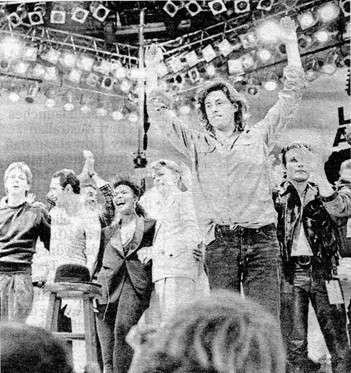
Live Aid was the largest Rock ‘n’ Roll benefit concert ever staged, broadcast on television on 13 July 1985. It utilised the latest live satellite technology to reach a worldwide audience from its two venues — Wembley Stadium in London and John F. Kennedy Stadium in Philadelphia, USA. Its simple aim was to raise a large sum of money to provide urgent famine relief for people in Ethiopia, saving lives from hunger and untimely death.
Live Aid was a spectacular success, attracting a worldwide audience of around 1.5 billion viewers in 160 countries and raising £40 million.
Forty years later, with the benefit of hindsight, watching Live Aid afresh now made me ponder how it compares with the UK National Lottery for fundraising.
Live Aid was effectively a one-off; the National Lottery started in November 1994 and continues to raise substantial sums for Good Causes regularly and sustainably.
Shall we find out?
Table of contents
Estimated reading time: 12 minutes
Famine in Ethiopia
Hearing reports of famine in war-torn parts of Ethiopia, BBC News sent its journalist Michael Buerk to the region to investigate and report on the situation. In October 1984, he compiled an extensive report with disturbing video footage featuring moving pictures of malnourished, emaciated people—men, women and children—suffering appalling hardship and deprivation. The report led to a watershed in how television covers humanitarian crises.
The images seen in one’s living room were deeply shocking; they were an affront to human dignity and caused a profound sense of moral outrage that demanded urgent action.
Pop music responds by releasing a Christmas single
Bob Geldof of the Boomtown Rats and his partner, Paula Yates, were appalled by what they saw. Bob teamed up with Ultravox’s Midge Ure to devise a plan to alleviate the situation. Their response was to form a band of fellow pop musicians to produce a Christmas single and raise money.
That song was “Do They Know It’s Christmas?” and the band “Band Aid”[1]. It was written hastily to meet the Christmas deadline and released on 7 December 1984. More than 40 musicians contributed.
The organisers hoped to raise £70,000; they made £8 million in the first year. The single reached number 1 in the hit singles charts and remained there for five weeks. A million copies were sold in the first week, and 3 million on New Year’s Eve alone.
There were critics, but the retort was that the money raised would undoubtedly save lives, and that would justify what had been done with the best of intentions.
Flushed with the success of the Band Aid single but frustrated by the overwhelming scale of the problem, Bob Geldof and others knew they had to do more.
A Rock Concert on two continents
Boy George of Culture Club suggested that the next logical step would be a charity concert. Bob Geldof picked up the idea. A massive concert would span two venues, linked by satellite and broadcast worldwide. The chosen venues would be London and Philadelphia. The audience would be enormous, resulting in a substantial volume of donations. “Give me your money” became the mantra.
There would be many acts. Musicians were persuaded and cajoled to take part.
The organisers, like Bob Geldof, made it clear from the outset their intention that the proceeds would go entirely to the cause. Most performers waived their fees and received no compensation for participating. Showing altruism would provide its reward; being seen taking part would suffice.
Behind the scenes, there were formal and informal meetings and phone calls involving impassioned arguments, discussions, emotional blackmail, arm-twisting, and wrangling. They would push back the frontiers of the possibility of staging an event of such consequence. Problems surrounding fees for TV broadcasting rights had to be negotiated and agreed upon with hard-nosed businesspeople who would be involved in the mechanics of the show.
The day arrives: 13 July 1985
It’s twelve noon in London, 7 am in Philadelphia, and around the world it’s time for Live Aid,
said broadcaster Richard Skinner at the start of the broadcast by the BBC from Wembley Stadium on Saturday, 13 July 1985. The concert continued until 10 pm BST.
In America, the concert began at 8:51 am EDT and ended at 11:05 pm EDT.
The concerts were a resounding success and have become etched in people’s memories. Some people likened them to a global jukebox. Ultimately, they raised £150 million for famine relief — the culmination of the effort and hard work done by many people consistently behind the scenes over six months and at considerable expense.
Technological problems
The concerts pushed satellite and communications technologies to their limits. The problems were significant, and there were glitches.
Raising such a large sum was remarkable then, being no mean feat in a time before the advent of mobile phones.
Furthermore, the Internet was in its infancy and primarily the domain of government, academia and the military. The Internet as we know it today did not exist, meaning there was no online electronic banking to transfer money easily, quickly and reliably.
Such facilities were nonexistent; this was the era of payment in cash and by cheques, slow and cumbersome. Television and radio dominated the media; there was no Facebook, Netflix, Twitter (X), YouTube or streaming. This world would be unfamiliar to millennials.
In Britain, the BBC operated 300 telephone lines to accept donations by credit card, using call handlers to take the necessary details. Also, the BBC’s live coverage repeated an address for postal donations by cheque at 20-minute intervals. Fundraising was labour-intensive.
Now, we shall turn our attention to the UK National Lottery to compare how effectively funds were raised.
The National Lottery
Background
The National Lottery began on 19 November 1994 with a single game, known originally as the Online Game. Later, it was renamed Lotto in 2002.
From the beginning, a board, costing £1, was the basic unit of play; it consisted of six unique numbers chosen from a total of 49.
The pattern remained the same in each drawing. A mechanism withdrew seven agitated balls from a drum in full view of a TV audience – the first six comprised the main balls, and the seventh, the bonus ball.
Players made their choices in advance of each draw by marking cells on playslips, which were read by special terminals. The retailer would print a ticket, give it to the player and accept payment in cash.

There was a simple prize structure of five prize tiers, ranging from a guaranteed minimum of £10 to a million pounds or more, usually. Matching five main balls and the bonus paid a handsome prize of around £100,000. The exact amounts of four of the five prize tiers depended on a set proportion of the ticket sales. i.e. the prizes were pari-mutuel.
Later, Lotto used 59 instead of 49 balls, doubled the price of a board, modified the prize structure, paid fixed prizes (except for the jackpot) and allowed entries online via the official National Lottery website or smartphone app.
In principle, any lottery is based on a draw in which numbers are picked at random. Players bet on the outcome to win prizes. Lotto is no exception.
Practical difficulties
However, in practice, it is no simple task to organise and operate a game nationally with large, attractive prizes regularly and fairly, maintaining the support, participation and goodwill of the public.
Draws are made mechanically. A computer, with a national network of dedicated terminals connected to it, accepts and records the bets and issues tickets. Millions of pounds have been spent building and enhancing the lottery infrastructure.
Impact
Like it or loathe it, the National Lottery has created hundreds of millionaires overnight and provided billions of pounds to charitable, good causes that would not otherwise have received such bounty through general taxation.
The lottery has been a lifesaver for many newsagents, corner shops, and convenience stores, boosting foot traffic and encouraging them to stay open outside of regular hours, thereby enlivening communities.

Thousands of retail outlets, including corner shops, newsagents, post offices, convenience stores and supermarkets, sell lottery tickets. Over the years, players have handed billions of pounds in banknotes and small change over the counter to pursue their dream of achieving financial independence and security.
Recently, players have been able to purchase lottery tickets online through an account with the National Lottery linked to their bank account and debit card, eliminating the need for cash and paper currency. The account also facilitates the direct payment of any prizes.
Major events
Additionally, the National Lottery contributed £2.2 billion towards the London 2012 Olympic and Paralympic Games, and numerous local projects, both big and small, have benefited from lottery grants year after year. Considerable wealth has been redistributed.
Changes
Over the past 30 years, there have been both good and bad times, marked by numerous social, economic, political, and technological changes since the introduction of the National Lottery. They include:
- Wars in Iraq and Afghanistan;
- Acts of terrorism such as 9/11;
- Financial upheaval, banking crises, recession, cuts in government spending;
- High immigration;
- Outsourcing work overseas;
- Less secure employment;
- Underemployment and unemployment;
- Globalisation and the re-balancing of the economy away from the traditional, heavy “smokestack” industries.
Any one of the above might militate against spending on good causes and also be detrimental to the average household budget.
However, the National Lottery has ensured that financial support has been available for good causes throughout its history. Credit is due to Camelot[2] for successfully sustaining the National Lottery since 1994 – a formidable achievement, in my opinion.
Evolution of the National Lottery
The National Lottery has not remained static. Games have evolved, been introduced and withdrawn over the years, according to their success at generating funds for good causes.

Charitable funds and prizes stem from ticket sales.
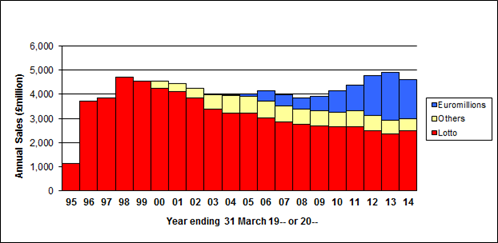

Each column in the bar chart allocates 28% of its value to the Good Causes. That’s roughly 28% of (70 × £60 million) – £1.2 billion.
Where the money goes
| Period | Before New Dawn[3] | After New Dawn[4] | ||
|---|---|---|---|---|
| Allocated to: | % | Amount | % | Amount |
| Lotto Prizes | 45% | 45p | 47.5%[5] | 95p |
| Good Causes | 28% | 28p | 28% | 56p |
| Lottery Duty to Exchequer | 12% | 12p | 12% | 24p |
| Commission to Retailers | 5% | 5p | 5% | 10p |
| Operating costs | 4.5% | 4.5p | ~ 4% | ~ 8p |
| Operator’s profits | 0.5% | 0.5p | 0.3% to 0.5%[6] | 0.6p to 1p |
| Retained for other uses | 5% | 5p | ~ 3% | ~ 6p |
| Total: | 100% | £1.00 | 100% | £2.00[7] |
Money raised for Good Causes
The lottery enterprise produced spectacular results in the first 25 years. According to Camelot, between November 1994 and September 2019, it raised £43 billion for Good Causes, paid out £56 billion in prizes and created 6,100 millionaires – benevolence on a large scale. This performance is impressive by any standard.
According to the Gambling Commission, between 19 November 1994 and the end of March 2025, the National Lottery has raised £50 billion for Good Causes, which include arts and heritage, sports, health, environment and education — a figure that equates to £32 million per week over 30 years (rounded down to the nearest million).
$$ \begin{split}\text{Good Causes weekly}& = \frac{50000}{30 \times 52}\\ \\&= 32 \text{ million GBP} \end{split} $$Conclusion
Over the last 30 years, the National Lottery has established a reliable infrastructure that enables it to raise vast sums of money for good causes consistently.
The system works by exploiting the propensity of a large proportion of the population aged 18 years and older to gamble small sums of money that they can afford regularly. Players are drawn to the slim chance of winning life-changing prizes while supporting charitable causes.
Prizes provide an incentive to purchase tickets and maintain a steady momentum in sales.
The National Lottery does not provide famine relief. In that way alone, it differs dramatically from Live Aid, whose primary aim was to provide urgent and life-saving humanitarian aid. However, the National Lottery continues to operate every week, supporting its causes effectively and efficiently.
In saying this, I am not seeking to undermine Live Aid or denigrate the passion that imbued it; on the contrary, I applaud and admire the effort and total commitment to its cause. But could its level of success be sustained for longer than a few weeks? I am not sure!
Much depends on your perspective.
- Suppose you represent the organiser of the lottery or a charity like Live Aid. In that case, you focus on the amount of money that you can reasonably raise after expenses.
- If you are a player or donor, your interest lies in the prizes on offer in Lotto, or the warm feelings of satisfaction and goodwill that your contribution might bring in saving lives (i.e., Live Aid).
Both sides are valid.
Notes
- [1] Band-Aid is a proprietary brand of adhesive bandage (i.e., sticking plaster) used to cover minor cuts and wounds, allowing them to heal without contamination from the outside.
- [2] Camelot held the licence to operate the National Lottery for nearly 30 years. The licenced operator from 1 February 2024 is now Allwyn UK.
- [3] Draws 1 to 1855 – Saturday, 19 November 1994 to Wednesday, 2 October 2013.
- [4] Draws 1856 to 2065 – Saturday, 5 October 2013 to Wednesday, 7 October 2015.
- [5] Beginning with draw 1856 on 5 October 2013, the New Dawn introduced a new prize structure for Lotto with additional raffle prizes of £20,000; Camelot dropped them later.
42.47% of the prize fund was allocated to Lotto prizes after the New Dawn, and 5.03% to the new Lotto Raffle. - [6] The operator’s profit depended up on the amount raised for Good Causes, and was capped at 0.5% maximum (i.e. 1p per board).
- [7] The cost per board doubled to £2 at the start of the New Dawn to fund the Raffle, and the Match 3 prize rose from £10 to £25.
Revision date: 17 July 2025