Evolution of the National Lottery – the first 20 years: part 2
The National Lottery has come a long way since it began as a single Online Game on 19 November 1994. Over time, Camelot has introduced initiatives to add more varied games, broaden the base of players, grow sales and increase the revenue of Good Causes.

The second part of this article describes the steps Camelot took to grow and develop the games of the National Lottery during the first twenty years. We shall gain insights into the process and the underlying thinking. It was a process of evolution – there were successes and failures. Some games succeeded while others did not.
Read: Part 1 of the Evolution of the National Lottery – the first 20 years.
Table of contents
- Eligibility
- Evolutionary steps
- Guaranteed jackpots and Superdraws
- Lucky Dips
- Increasing the frequency of play
- New games
- Adding fixed prizes
- Jackpot only games
- Seasonal games
- Collaboration with lotteries outside the UK
- Games specifically for one Good Cause
- Adding Raffles
- Changing the Prize Structure
- Providing other channels to buy tickets
- Notes
Estimated reading time: 0 minutes
Eligibility
Players must have resided in the UK or Isle of Man, be physically present when they bought their tickets and aged over 15 to participate during these twenty years[2].
Evolutionary steps
The lottery enterprise did not remain static but has evolved over the years, as Camelot has strived to increase the income of Good Causes under the terms of its licence agreements. The National Lottery needed to retain and engage new players to thrive.
Camelot achieved these goals by attracting new players with a spectrum of games having diverse prize structures to meet different needs. Some succeeded; others did not.
The games had different formats, prize structures, and costs and included raffles. Favourites were enhanced or modified. Some, like Thunderball, caught on, have thrived and endured, while others proved to be unpopular and had a short life.
Camelot has tried several strategies over the years, singly or in combination; they had varying degrees of success and included the following.
Guaranteed jackpots and Superdraws
Occasionally, Camelot provides jackpots larger than sales would allow under normal circumstances and supplementary jackpots[3]. We looked closely at the relationship between sales and prizes earlier.
For example,
- Anniversaries, and around Christmas and the New Year – Draw 208, held on Saturday, 20 December 1997, had a £25 million Superdraw; two ticket holders won £12,500,000 each.
- To promote significant changes to an existing game (such as the New Dawn for Lotto on 5 October 2013, doubling the cost of entry; it was a £10 million Superdraw with one outright winner).
- Celebrating special occasions like the late Queen’s Golden Jubilee on 6 February 2002 with a draw (672) on Saturday, 1 June 2002, in which six winners shared a Superdraw jackpot of £10 million.
Lucky Dips

Lucky Dips offer a quick and easy solution for players who need help with how to play and for those who might agonise over their choice of numbers. They were introduced for the Lotto draw on 23 March 1996. Subsequently, all games make provision for Lucky Dips.
Read: Lucky Dips for more information.
Increasing the frequency of play
The National Lottery introduced regular draws on Wednesdays in addition to Saturdays from draw 117 on Wednesday, 5 February 1997 onwards.

Draws 117 and 119[4] (12 February 1997) had guaranteed jackpots of £10 million to promote the new draw schedule; similarly, draws 121 (19 February 1997) and 123 (26 February 1997) had guaranteed jackpots of £7 million.
Then, sales for Saturdays were approximately double those for Wednesdays typically.
Thunderball
The play slips chart part of the development of Thunderball over the twenty years.


Originally, Thunderball was played on Saturdays from 12 June 1999. Recurring Wednesday, Friday and Tuesday games were added on
- Wednesday, 23 October 2002 (draw 177)
- Friday, 14 May 2010 (draw 966) and
- Tuesday, 30 January 2018 (draw 2174).
New games
| Game | Began | Ended | Remarks |
|---|---|---|---|
| Lotto | 19/11/1994 | – | The original flagship game – 7 numbers drawn from 49; re-branded as Lotto in 2002. Usually, the jackpot exceeds £1 million.
The player picks 6 balls from 49, hoping to match the six main balls drawn.
|
| Thunderball | 12/06/1999 | – | Five numbers drawn from 34 originally, plus 1 from 14 (the Thunderball). Draws were made on Saturdays initially. The prizes were fixed and spread over 8 tiers. Maximum prize : £250,000. Players choose 5 main balls and one Thunderball to win a prize. |
| Lotto Hotpicks | 10/07/2002 | – | Lotto Hotpicks is an independent game with fixed prizes. It is a companion of Lotto, sharing the same main numbers, but with a different prize structure and rules. Initially, there were three distinct games to play – Pick 2 of 2, Pick 3 of 3, and Pick 4 of 4. Lotto Hotpicks was introduced to counter a threat from UK bookmakers, who had piggy-backed Lotto to offer higher prizes in the lower tiers, particularly Match 3, 4 and 5. The alternatives used the numbers drawn in UK and Irish lotteries, but applied different rules. They had different odds of winning. Similarities were superficial, not like for like, making exact comparisons difficult. |
| Euromillions | 13/02/2004 | – | Pan-European game with huge jackpots. Tickets cost £1.50 each. Players choose 5 main balls from 50, and two Lucky Stars from 9 to match those drawn to win prizes in 12 tiers. |
| Daily Play | 22/09/2003 | 06/05/2011 | Each board cost £1. Players chose 7 numbers from 27 to win prizes in 5 tiers. Matching none with the seven numbers drawn won a free Lucky Dip. There were fixed cash prizes for matching 4, 5, 6 and 7 numbers with a maximum of £30,000. Daily Play was not played on Sundays or Christmas Day. Altogether, 2,380 games were played before the game ended. |
| Dream Number | 15/07/2006 | 09/02/2011 | The Dream Number game supported the 2012 Olympic and Paralympic Games in London with 478 games. Each Dream Number consisted of seven digits. There were fixed prizes with a maximum of £500,000. Boards were bundled with Lotto for an optional additional fee of £1. This game was unique in that the order in which the numbers were drawn mattered. |
| Lotto Extra | 15/11/2000 | 08/07/2006 | Lotto Extra was a jackpot only game derived from Lotto with jackpots rising from £1 million. It was based on 6 main numbers. To take part, players bought a ticket in conjunction with Lotto at an additional cost of £1 per board. |
| Lotto Plus 5 | 13/02/2011 | 01/10/2013 | Essentially, Lotto Plus 5 was identical to Lotto, but with fixed prizes. It was played in conjunction with Lotto with draws on days other than Wednesdays and Saturdays. Plus 5 had a jackpot of £250,000 and ended just before the New Dawn for Lotto after 688 draws. |
| Lotto Raffle | 05/10/2013 | 17/11/2018 | There were five tiers of prizes eventually, ranging from £20,000 to £1,000,000 with guaranteed winners. |
| Big Draw 2000 and 2001 | Nov 1999 Dec 2000 | One-offs | Each consisted of 2 distinct games drawn at New Year. Tickets were £5 each. |
| Christmas Millionaire Maker 2001 to 2003 | Nov 2001 Nov 2002 Nov 2003 | One-offs | Similar to the Big Draw, but took place on Christmas Eve. In these games, the numbers drawn were years. e.g. 1999. |
Lotto with Plus 5


Adding fixed prizes
Thunderball was the first game in the National Lottery portfolio to have fixed prizes throughout. Daily Play, Lotto Plus 5, and Dream Number had fixed prizes, too.
The competitors fight back
High street bookmakers and betting shops specialised in horse and greyhound racing, and many bingo halls operated in larger towns and cities. Collectively, they had a high turnover. Both feared that a significant proportion of their income would be diverted to the National Lottery.
Their concerns were justified. The number of licenced bingo clubs had fallen by 122 to 781, and more than 800 betting shops had closed by the first anniversary of the National Lottery, according to the Betting Offices Licensees Association.
Betting shops could not compete against National Lottery jackpots; they had neither the scale nor the financial clout. However, they spotted an opportunity to compete commercially against prizes in the bottom tiers of the National Lottery’s prize structure.
In the first five years of the National Lottery, the average prizes in the lower tiers, Match 3, 4 and 5, were as follows.
| Statistic | Match 3 | Match 4 | Match 5 |
|---|---|---|---|
| Mean | £10 (fixed) | £67 | £1,823 |
| Minimum | £16 | £181 | |
| Maximum | £164 | £7,786 | |
| Median | £65 | £1,669 | |
| Weighted mean | £62 | £1,525 |
The table below shows that buying a Lotto board gives you many chances of winning across the tiers.
| Category | Condition | Example(s) | Possibilities |
|---|---|---|---|
| Match 3 | Any 3 main balls | (3, 5, 14) or (5, 30, 44) | 6C3 = 20 |
| Match 4 | Any 4 main balls | (3, 5, 14, 22) or (5, 22, 30, 44) | 6C4 = 15 |
| Match 5 | Any 5 main balls | (5, 14, 22, 30, 44) | 6C5 = 6 |
| Match 5+ | Any 5 main balls & bonus ball | (5, 14, 22, 30, 44) and 10 | 6C5 = 6 |
| Match 6 | All main balls | (3, 5, 14, 22, 30, 44) | 6C6 = 1 |
e.g. Buying the board (3, 5, 14, 22, 30 and 44) provides 20 opportunities for a Match 3 prize, 15 for Match 4 and 6 for Match 5.
The National Lottery’s competitors used the numbers drawn in the UK and Irish lottery games. They managed to shift players’ gaze to focus on the lower-tiered prizes, which were easier to win.
Different rules applied
Playing to different rules meant they could offer higher prizes commercially, making Camelot’s prizes look mean and giving themselves a marketing advantage. Their argument was convincing at face value; their prizes were higher, but the odds differed.
Sometimes, looks can be deceptive. Look more closely, and you will see that any similarities were superficial, not like for like, making exact comparisons difficult. In effect, they were side-shows over which the National Lottery had no control[5]. We shall investigate.
Camelot’s countermeasures
Camelot argued that these side-shows undermined the National Lottery by taking money away from them and thus depriving the Good Causes. For its part, the Government wanted to shield the lottery. It sought to introduce legislation to prevent other organisations from using lottery draws as the basis for their business.
In the interim, Camelot introduced Lotto Hotpicks to counter the threat from UK bookmakers, who had piggy-backed Lotto to provide higher prizes in the lower tiers, notably Match 3, 4 and 5.
Lotto Hotpicks
Lotto Hotpicks began alongside Lotto Draw 683 on Wednesday, 10 July 2002. Lotto and Lotto Hotpicks share the same six main balls. However, the bonus ball is irrelevant in Hotpicks.
Camelot used Hotpicks to challenge its competitors by mimicry.
| Matches | Prize | Winning criterion to qualify | From | Remark |
|---|---|---|---|---|
| Match 1 of 1 | £5 | Your chosen ball must be among the six main balls. e.g. {17} in {16, 17, 21, 27, 30, 37} | 26 Oct 2005 | There is no prize for matching one ball in Lotto. |
| Match 2 of 2 | £40 | Both your chosen balls must be among the six main balls. e.g. {17, 19} in {5, 15, 17, 19, 20, 47} | 10 Jul 2002 | Matching two numbers in Lotto did not qualify for a prize during the twenty-year period, not until
the start of enhanced Lotto played with 59 balls instead of 49.
|
| Match 3 of 3 | £450 | All three of your chosen balls must be among the six main balls. e.g. {11, 27, 36} in {4, 11, 27, 34, 36, 45} | 10 Jul 2002 | These prizes seemed far more attractive than Lotto for the same number of matches, or so it appeared! |
| Match 4 of 4 | £7,000 | All four of your chosen balls must be among the six main balls. e.g. {12, 26, 33, 45} in {5, 12, 21, 26, 33, 45} | 10 Jul 2002 | |
| Match 5 of 5 | £130,000 | All five of your chosen balls must be among the six main balls. e.g. {15, 24, 26, 31, 35} in {12, 15, 24, 26, 31, 35} | 26 Oct 2005 |
Here is the play slip that catered for the game, supporting the additional Pick 1 of 1 and Pick 5 of 5 options.

What about the chances of winning?
Calculating the odds
In a simple experiment involving pass or fail trials, suppose there are a successes and b failures. The total number of trials undertaken is the sum of the successes and failures. i.e. (a + b).
The probability of success, p, is the number of successes divided by the number of trials.
i.e. p = a / (a + b)
Meanwhile, the probability of failure, p′, is the number of failures divided by the number of trials.
i.e. p′ = b / (a + b)
It follows that (p + p′) = 1, which is an important and valuable result, easing our labour.
The odds in favour of success, Of, is the number of successes divided by the number of failures.
i.e. Of = a / b.
Often, this is expressed as a ratio, written as a : b, normalised as 1 : (b/a).
Also, since Of = p / p′, the odds in favour of success is the ratio of p : p′, or normalised as 1 : (p/p′).
Example
For example, to determine the odds in favour of winning Pick 2 of 2 prizes, we should find how many times two balls, say {5, 17}, occur in the complete list of 13,983,816 sextuples arranged in ascending order from {1, 2, 3, 4, 5, 6} to {44, 45, 46, 47, 48, 49} inclusively by
- counting them iteratively in a computer program[6] or
- using the mathematical hypergeometric distribution function[7].
The results are the same whichever method we apply.
| Category | Success | Failure | Total | Probability(counted) | Probability(calculated) | Odds Of | |||
|---|---|---|---|---|---|---|---|---|---|
| Pick | (a) | (b) | (a + b) | Success (p) | Failure (p′) | Success (p) | Fail (p′) | Raw (a : b) | Normalised |
| 1 of 1 | 1,712,304 | 12,271,512 | 13,983,816 | 1.224 × 10⁻¹ | 8.776 × 10⁻¹ | 1.224 × 10⁻¹ | 8.776 × 10⁻¹ | 1,712,304 : 12,271,512 | 1 : 7 |
| 2 of 2 | 178,365 | 13,805,451 | 13,983,816 | 1.276 × 10⁻² | 9.872 × 10⁻¹ | 1.276 × 10⁻² | 9.872 × 10⁻¹ | 178,365 : 13,805,451 | 1 : 77 |
| 3 of 3 | 15,180 | 13,968,636 | 13,983,816 | 1.086 × 10⁻³ | 9.989 × 10⁻¹ | 1.086 × 10⁻³ | 9.989 × 10⁻¹ | 15,180 : 13,968,636 | 1 : 920 |
| 4 of 4 | 990 | 13,982,826 | 13,983,816 | 7.080 × 10⁻⁵ | < 1 | 7.080 × 10⁻⁵ | < 1 | 990 : 13,982,826 | 1 : 14,124 |
| 5 of 5 | 44 | 13,983,772 | 13,983,816 | 3.146 × 10⁻⁶ | < 1 | 3.146 × 10⁻⁶ | < 1 | 44 : 13,983,772 | 1 : 317,813 |
For the sake of completeness, we should repeat the exercise for the version of Lotto with 59[8] balls, in which there are 45,057,474 combinations, ranging from {1, 2, 3, 4, 5, 6} to {54, 55, 56, 57, 58, 59}.
| Category | Success | Failure | Total | Probability(counted) | Probability(calculated) | Odds, Of | |||
|---|---|---|---|---|---|---|---|---|---|
| Pick | (a) | (b) | (a + b) | Success (p) | Failure (p′) | Success (p) | Fail (p′) | Raw (a : b) | Normalised |
| 1 of 1 | 4,582,116 | 40,475,358 | 45,057,474 | 1.017 × 10⁻¹ | 8.983 × 10⁻¹ | 1.017 × 10⁻¹ | 8.983 × 10⁻¹ | 4,582,116 : 40,475,358 | 1 : 9 |
| 2 of 2 | 395,010 | 44,662,464 | 45,057,474 | 8.767 × 10⁻³ | 9.912 × 10⁻¹ | 8.767 × 10⁻³ | 9.912 × 10⁻¹ | 395,010 : 44,662,464 | 1 : 113 |
| 3 of 3 | 27,720 | 45,029,754 | 45,057,474 | 6.152 × 10⁻⁴ | 9.994 × 10⁻¹ | 6.152 × 10⁻⁴ | 9.994 × 10⁻¹ | 27,720 : 45,029,754 | 1 : 1,624 |
| 4 of 4 | 1,485 | 45,055,989 | 45,057,474 | 3.296 × 10⁻⁵ | < 1 | 3.296 × 10⁻⁵ | < 1 | 1,485 : 45,055,989 | 1 : 30,341 |
| 5 of 5 | 54 | 45,057,420 | 45,057,474 | 1.198 × 10⁻⁶ | < 1 | 1.198 × 10⁻⁶ | < 1 | 54 : 45,057,420 | 1 : 834,397 |
Counting
Only combinations of lottery balls containing the numbers picked (e.g. Pick 2 of 2, say {5, 17}) are counted.
| Set A | Set B | A ∪ B | Result | Counted |
|---|---|---|---|---|
| {5, 17} | {1, 2, 3, 4, 5, 6} | {1, 2, 3, 4, 5, 6, 17} | A ⊄ B | No |
| {5, 17} | {1, 13, 17, 29, 37, 48} | {1, 5, 13, 17, 29, 37, 48} | A ⊄ B | No |
| {5, 17} | {2, 4, 5, 11, 17, 49} | {2, 4, 5, 11, 17, 49} | A ⊂ B | Yes |
| {5, 17} | {5, 17, 20, 25, 37, 43} | {5, 17, 20, 25, 37, 43} | A ⊂ B | Yes |
| {5, 17} | {17, 19, 23, 29, 32, 45} | {5, 17, 19, 23, 29, 32, 45} | A ⊄ B | No |
| {5, 17} | {44, 45, 46, 47, 48, 49} | {5, 17, 44, 45, 46, 47, 48, 49} | A ⊄ B | No |
Hypergeometric Distribution Function
In general, the hypergeometric distribution function calculates the probability of x successes in a sample from its sample size (n), the number of successes (M) in a population, and the population size (N).
In our case, x and n correspond to Pick x of n from M balls out of N.
$$ \begin{align*}Probability(x; n)& = \frac{\binom{M}{x} × \binom{N-M}{n-x}}{\binom{N}{n}}≡\frac{^{M}C_x × \thinspace^{N-M}C_{n-x}}{^{N}C_n}\\ \end{align*} $$Lotto Hotpicks awards prizes to players who match Pick 1 of 1, …, to Pick 5 of 5, meaning that x and n have the same value. i.e. 1, 2, 3, 4 or 5.
Lotto Hotpicks uses six main balls out of 49 (or 59 later), so M = 6 and N = 49 (or 59).
Considering the specific case of Pick 2 of 2 using 49 balls, the formula is:
$$ \begin{align*}Probability(2; 2)& = \frac{\binom{6}{2} \thinspace× \binom{49-6}{2-2}}{\binom{49}{2}}=\frac{^{6}C_2 \thinspace× \thinspace^{43}C_0}{^{49}C_2}\\ \\&=0.01275510 \end{align*} $$Conclusion
It becomes clear that the odds of winning Hotpicks (and its close equivalents) differ substantially from Lotto. Fair comparisons are difficult to make in practice.
I leave you with this thought before closing the topic of Lotto Hotpicks, especially among you who play the same numbers for fear of missing out.
If you had played Pick 3 of 3 on Lotto Hotpicks with the same three balls (e.g. {1, 7, 20}) from the beginning up to the New Dawn, you would have won nothing since that triplet was never drawn – nor were 2,412 others, seemingly contradicting the notion that favourable things are likely to happen in the long run!
In this instance, the long run corresponded to 1,173 draws, producing no return on £1,173 spent if you bought a Pick 3 of 3 board with {1, 7, 20} in every Hotpicks draw.
Read: Coverage up to the New Dawn for Lotto for more information.
Jackpot only games
Lotto Extra
Lotto Extra was a jackpot-only game played with Lotto over 590 draws between Wednesday, 15 November 2000 and Saturday, 8 July 2006. It was designed to produce the excitement of high jackpots after Camelot introduced Lucky Dips. Lucky Dips had made higher jackpots less likely in Lotto.


Then, the two games were known as the National Lottery and Lottery Extra until 18 May 2002, when Camelot rebranded them as Lotto and Lotto Extra to reverse declining sales. The comedian Billy Connolly fronted an advertising campaign to promote the change.
The table below compares the overall performance of Lotto and Lotto Extra.
| Category | Lotto | Lotto Extra |
|---|---|---|
| Number of draws | 590 | 589 |
| Number of jackpots | 470 | 32 |
| Maximum winners | 15 | 3 |
| Total winners | 1,266 | 35 |
| Average jackpot per winner | £1,273,760 | £6,728,645 |
| Minimum jackpot | £216,650 | £1,000,000 |
| Maximum jackpot | £20,100,472 | £20,000,000 |
Eventually, Lotto Extra acted as a disincentive for Euromillions, which had begun on 13 February 2004. Euromillions was slow to catch on in the UK at the start. While Lotto Extra could provide large jackpots, perhaps the British public could see no need for a seemingly foreign game.
Why was Lotto Extra dropped?
Here is my opinion.
- Lotto Extra had served its purpose in saving Camelot from reforming the original game, known now as Lotto, due to the fierce criticism and moral backlash that ensued after some early huge jackpots. The game had only recently established itself in the public’s mind and gained favour; sweeping changes might have been detrimental to the income of the Good Causes. Why rock the boat needlessly?
- Sales of Lotto Extra had begun to decline.
- Players had to opt in to play Lotto Extra. It was easy to dismiss or ignore this game.
- Camelot had joined forces with other European lotteries, producing a much larger pool of players with higher sales and the prospect of jaw-dropping, life-changing jackpots. Wouldn’t it be better to wean Britons off Lotto Extra and offer them Euromillions as a viable and attractive alternative?
The Decline of Lotto Extra
The decline becomes evident if you plot the elapsed draws and value of each Lotto Extra jackpot against jackpot ID as a column chart like the one below and based on the subsequent table. We shall ignore the final jackpot (i.e., the 33rd) since it was divided between Match 5 winners rather than the usual Match 6.

Usually, Lottery Extra jackpots began with a guaranteed £1 million. They increased proportionately with ticket sales, but some (i.e. 4, 5 and 6) started with £4 million. The third ended with £20 million guaranteed after 28 consecutive draws.
Observe that later jackpots needed more draws to accumulate value as time passed, indicative of declining sales through disinterest or an alternative provision.
| Jackpot | Number of draws | Jackpot | Accumulated from | ||||
|---|---|---|---|---|---|---|---|
| ID | Draw | Date | (£million) | Reported | Draw | Date | |
| 1 | 19 | Wednesday, 17 Jan 2001 | 19 | £12.7 | £12,668,755 | 1 | Wednesday, 15 Nov 2000 |
| 2 | 24 | Saturday, 3 Feb 2001 | 5 | £3.0 | £2,988,486 | 20 | Saturday, 20 Jan 2001 |
| 3 | 52 | Saturday, 12 May 2001 | 28 | £20.0 | £20,000,000 | 25 | Wednesday, 7 Feb 2001 |
| 4 | 66 | Saturday, 30 Jun 2001 | 14 | £10.5 | £10,500,000 | 53 | Wednesday, 16 May 2001 |
| 5 | 80 | Saturday, 18 Aug 2001 | 14 | £10.5 | £10,500,000 | 67 | Wednesday, 4 Jul 2001 |
| 6 | 84 | Saturday, 1 Sep 2001 | 4 | £5.5 | £5,500,000 | 81 | Wednesday, 22 Aug 2001 |
| 7 | 105 | Wednesday, 14 Nov 2001 | 21 | £15.5 | £15,528,286 | 85 | Wednesday, 5 Sep 2001 |
| 8 | 124 | Saturday, 19 Jan 2002 | 19 | £10.2 | £10,166,103 | 106 | Saturday, 17 Nov 2001 |
| 9 | 125 | Wednesday, 23 Jan 2002 | 1 | £1.0 | £1,000,000 | 125 | Wednesday, 23 Jan 2002 |
| 10 | 134 | Saturday, 23 Feb 2002 | 9 | £4.7 | £4,744,343 | 126 | Saturday, 26 Jan 2002 |
| 11 | 160 | Saturday, 25 May 2002 | 26 | £13.9 | £13,915,108 | 135 | Wednesday, 27 Feb 2002 |
| 12 | 172 | Saturday, 6 Jul 2002 | 12 | £5.7 | £5,727,366 | 161 | Wednesday, 29 May 2002 |
| 13 | 174 | Saturday, 13 Jul 2002 | 2 | £1.4 | £1,406,588 | 173 | Wednesday, 10 Jul 2002 |
| 14 | 197 | Wednesday, 2 Oct 2002 | 23 | £9.2 | £9,162,975 | 175 | Wednesday, 17 Jul 2002 |
| 15 | 199 | Wednesday, 9 Oct 2002 | 2 | £1.3 | £1,322,830 | 198 | Saturday, 5 Oct 2002 |
| 16 | 202 | Saturday, 19 Oct 2002 | 3 | £1.6 | £1,645,181 | 200 | Saturday, 12 Oct 2002 |
| 17 | 216 | Saturday, 7 Dec 2002 | 14 | £5.0 | £5,026,224 | 203 | Wednesday, 23 Oct 2002 |
| 18 | 218 | Saturday, 14 Dec 2002 | 2 | £1.3 | £1,338,083 | 217 | Wednesday, 11 Dec 2002 |
| 19 | 254 | Saturday, 19 Apr 2003 | 36 | £14.3 | £14,265,140 | 219 | Wednesday, 18 Dec 2002 |
| 20 | 260 | Saturday, 10 May 2003 | 6 | £2.6 | £2,602,960 | 255 | Wednesday, 23 Apr 2003 |
| 21 | 294 | Saturday, 6 Sep 2003 | 34 | £13.9 | £13,863,185 | 261 | Wednesday, 14 May 2003 |
| 22 | 308 | Saturday, 25 Oct 2003 | 14 | £5.2 | £5,154,428 | 295 | Wednesday, 10 Sep 2003 |
| 23 | 326 | Saturday, 27 Dec 2003 | 18 | £6.0 | £5,957,937 | 309 | Wednesday, 29 Oct 2003 |
| 24 | 336 | Saturday, 31 Jan 2004 | 10 | £3.4 | £3,410,359 | 327 | Wednesday, 31 Dec 2003 |
| 25 | 390 | Saturday, 7 Aug 2004 | 54 | £21.1 | £21,118,407 | 337 | Wednesday, 4 Feb 2004 |
| 26 | 409 | Wednesday, 13 Oct 2004 | 19 | £6.6 | £6,572,341 | 391 | Wednesday, 11 Aug 2004 |
| 27 | 431 | Wednesday, 29 Dec 2004 | 22 | £6.7 | £6,723,316 | 410 | Saturday, 16 Oct 2004 |
| 28 | 474 | Saturday, 28 May 2005 | 43 | £12.8 | £12,835,726 | 432 | Saturday, 1 Jan 2005 |
| 29 | 513 | Wednesday, 12 Oct 2005 | 39 | £10.4 | £10,417,926 | 475 | Wednesday, 1 Jun 2005 |
| 30 | 546 | Saturday, 4 Feb 2006 | 33 | £8.3 | £8,308,023 | 514 | Saturday, 15 Oct 2005 |
| 31 | 548 | Saturday, 11 Feb 2006 | 2 | £1.2 | £1,240,006 | 547 | Wednesday, 8 Feb 2006 |
| 32 | 577 | Wednesday, 24 May 2006 | 29 | £6.5 | £6,484,554 | 549 | Wednesday, 15 Feb 2006 |
| 33 | 590 | Saturday, 8 Jul 2006 | 13 | £3.3 | £3,269,814 | 578 | Saturday, 27 May 2006 |
| Total: | 590 | £255.4 | £255,364,450 | ||||
Special occasions
| Draw | Date | Balls | Winners | Prizes | Remarks | |||||
|---|---|---|---|---|---|---|---|---|---|---|
| 668 | 18 May 2002 | 15 | 26 | 29 | 40 | 44 | 48 | 1 | £4,000,000 | First of three additional draws to mark the introduction of the Lotto brand. |
| 4 | 5 | 33 | 37 | 42 | 46 | 5 | £800,000 | Second of three additional draws to mark the introduction of the Lotto brand. | ||
| 6 | 16 | 22 | 25 | 29 | 48 | 5 | £800,000 | Third of three additional draws to mark the introduction of the Lotto brand. | ||
| 672 | 1 Jun 2002 | 6 | 15 | 24 | 26 | 31 | 48 | 4 | £2,500,000 | Additional draw to celebrate the Golden Jubilee of Queen Elizabeth II. |
| 926 | 6 Nov 2004 | 5 | 17 | 23 | 26 | 42 | 48 | 6 | £1,666,667 | Additional draw to mark the tenth anniversary of the principal National Lottery online game, known now as Lotto. |
| 1080 | 29 Apr 2006 | 4 | 10 | 23 | 36 | 37 | 49 | 3 | £1,666,667 | Additional draw to precede the Monday draws of the rival charities lottery run by Chariot. |
Seasonal games
With tickets priced at £5 each, the Christmas Millionaire Maker and Big Draw games were intended to produce big jackpots at Christmas and New Year. They did not!
The games had been inspired by the advent of the new Millennium. However, the format needed to be more straightforward and seemed alien to the culture of play established by Lotto and Thunderball.
Below is a play slip for Big Draw 2000 and my Christmas Millionaire Maker 2001 ticket. I didn’t win a prize in either draw.


There were two Big Draws and three Christmas Millionaire Maker games.
- Big Draw 2000 was held on Friday, 31 December 1999, and Saturday, 1 January 2000, straddling midnight and televised on the BBC.
- Both games of Big Draw 2001 were held on Monday, 1 January 2001 and broadcast live on TV.
- Christmas Millionaire Maker 2001 was held on Monday, 24 December 2001. There were two games. As usual, you could choose six years from 100 for the first game, but the terminal would automatically pick two years for the second on your behalf.
- Christmas Millionaire Maker 2002 – held on Tuesday, 24 December 2002.
- Christmas Millionaire Maker 2003 – held on Wednesday, 24 December 2003.
The games were abandoned, and the format has yet to be revived.
Read: The Millennium and the Big Draw 2000 for more information.
Collaboration with lotteries outside the UK
Background
Sales of scratch cards and tickets for draw-based games fell in 2001/2 and 2002/3.
Camelot acted to help sales recover in part. Their actions included:
- scratch card games that could be played through the internet,
- a new draw-based game called Hotpicks that began on 10 July 2002,
- and a mid-week version of Thunderball, starting from 23 October 2002.
However, they needed to do more to revitalise, stabilise and increase sales to meet the financial targets of the Good Causes. Also, there was a realistic prospect of staging the Olympic Games in London[9] in 2012, and the Government was seeking help with funding.
Camelot submitted a proposal to the National Lottery Commission to stimulate growth in sales. There would be a new daily draw-based game called Daily Play and another to fund the Olympic Games[10] specifically.
Camelot joins forces to create a pan-European game
Furthermore, Camelot announced that it planned to partner with the French and Spanish national lotteries to create a European game with a player base nearly three times that of the UK alone. Therefore, it should be able to offer much higher jackpots than Lotto from higher sales – assuming the venture could capture the attention of the British public.
That game became Euromillions. It is still played actively, unlike Dream Number and Daily Play, which have been discontinued. The first draw took place on Friday, 13 February 2004.
The partnership was extended to include national lottery operators from Austria, Belgium, Ireland, Luxembourg, Portugal, and Switzerland from 8 October 2004 onwards. Such enlargement[11] meant Euromillions had a vast pool of eligible players to draw sales and could sustain bumper jackpots regularly, regardless of British participation.
Since 10 May 2011, there have been draws on Tuesdays and Fridays. Also, another prize tier, Match 2 with no Lucky Stars, was added to the original twelve, making thirteen in all.
As such, Euromillions complements other national lottery games rather than competing with them directly.
Playing Euromillions
To participate, a player had to select a board of five main numbers between 1 and 50 and two Lucky Stars between 1 and 9 initially, then between 1 and 11 from 10 May 2011, when Tuesday draws made their debut.

| From | Price (£) | Remarks |
|---|---|---|
| 13 Feb 2004 | £1.50 | Initial UK price. |
| 7 Nov 2009 | £2.00 | An unfavourable EUR/GBP exchange rate prompted the rise. The price included entry into the Millionaire Raffle (later called Millionaire Maker). |
| 24 Sep 2016 | £2.50 | The price increased when the number of Lucky Stars rose from 11 to 12. |

Thirteen prize tiers combine different numbers of main balls and Lucky Stars.
- The prize attached to the bottom tier is typically £3, just enough to cover your stake.
- Matching all five main numbers and two Lucky Stars wins the jackpot.
Jackpots can be huge; they were capped at €185 million from 7 November 2009, but the cap rose to €190 million from 12 January 2012.
The table below shows the probability of winning the Euromillions jackpot as the game has evolved and how the odds have worsened to favour multiple rollovers and bumper jackpots.
| Combinations of Main Balls | … and Lucky Stars | Probability (1 ÷ combinations) | ||
|---|---|---|---|---|
| 5 from 50 | 2 from 9 | 2 from 11 | 2 from 12 | |
| 50C5 | 9C2 | 11C2 | 12C2 | |
| 2,118,760 × | 36 | 55 | 66 | |
| From 7 February 2004 | 76,275,360 | – | – | 1.31104 × 10⁻⁸ |
| From 10 May 2011 | – | 116,531,800[12] | – | 8.58135 × 10⁻⁹ |
| From 24 September 2016 | – | 139,838,160 | 7.15112 × 10⁻⁹ | |
Supplementary games
Some national operators held supplementary games to accompany Euromillions.
| Country | Operator | Additional game | Prize |
|---|---|---|---|
| UK | Camelot | Millionaire Raffle Entered automatically. | £1,000,000 guaranteed |
| France | Française des Jeux (FDJ) | My Million There is an additional charge of 50c. | €1,000,000 guaranteed |
| Ireland | An Post National Lottery Company | Euromillions Plus There is an additional charge of €1. | € 500,000 |
| Portugal | Santa Casa da Misericórdia de Lisboa (SCML) | Euromillions Plus There is an additional charge of €1. | € 500,000 |
Slow pace
Take-up of Euromillions was slow in the United Kingdom at the start. The reasons were unclear. Perhaps the public did not need a foreign game, while Lotto Extra could provide such lucrative jackpots. A few significant wins changed that and stimulated lasting interest.
Sales of Euromillions began to improve after a player in Ireland won €115 million (£77 million) on 29 July 2005; this winner was close to home for UK players! A year later, Lotto Extra closed, so higher jackpots could be obtained only through Euromillions.
There was a more noticeable rise in sales during 2009/2010.
If the public had harboured any xenophobic thoughts that British pounds would go to line Continental pockets en masse, then such thoughts were dispelled very quickly. The following tables show clearly that British players have had their fair share of jackpots by number and value.
| Year ending 31 March | UK Sales[13] (£million) | Total Sales[14] (£million) | % UK |
|---|---|---|---|
| 2004 | £15.0 | £144.6 | 10.4% |
| 2005 | £104.0 | £1,273.0 | 8.2% |
| 2006 | £435.0 | £3,113.3 | 14.0% |
| 2007 | £455.8 | £3,148.6 | 14.5% |
| 2008 | £475.8 | £3,056.6 | 15.6% |
| 2009 | £618.3 | £3,908.8 | 15.8% |
| 2010 | £880.6 | £4,556.4 | 19.3% |
| 2011 | £1,055.5 | £4,238.3 | 24.9% |
| 2012 | £1,666.1 | £6,160.9 | 27.0% |
| 2013 | £1,984.0 | £6,053.1 | 32.8% |
| 2014 | £1,609.2 | £5,471.9 | 29.4% |
| 2015 | £1,596.7 | £5,002.3 | 31.9% |
Initially, the price per board in the UK was £1.50, approximately €2. After the financial crisis of 2008, the exchange rate between the pound and the euro tipped adversely against the pound.
Camelot responded by introducing the Millionaire Raffle in November 2009 and increasing the price of a board to £2 accordingly to pay for it.
Buying a Euromillions board provides simultaneous access to the Millionaire Raffle but with no say in the raffle ticket number, which Camelot’s system chooses on the player’s behalf.
The introduction of the Millionaire Raffle, coupled coincidentally with several huge jackpots paid to UK winners in 2009/10 and 2010/11, caught the imagination of the British public, causing sales to rise dramatically.
| Date of draw | Prize (£) | UK/Total Winners | Remarks |
|---|---|---|---|
| 6 November 2009 | £45,570,835.50 | 2/2 | Both winning tickets in UK |
| 12 February 2010 | £56,008,113.20 | 1/2 | A Spanish ticket won, too |
| 14 May 2010 | £84,451,320.60 | 1/1 | Single UK ticket |
| 8 October 2010 | £113,019,926.00 | 1/1 | Single UK ticket |
| 12 July 2011 | £161,653,000.00 | 1/1 | Single UK ticket |
| 7 October 2011 | £101,203,600.00 | 1/1 | Single UK ticket |
| 10 August 2012 | £148,656,000.00 | 1/1 | Single UK ticket |
| 28 May 2013 | £81,381,673.30 | 1/1 | Single UK ticket |
| 14 March 2014 | £107,932,603.20 | 1/1 | Single UK ticket |
| 2 May 2014 | £73,205,659.50 | 1/1 | Single UK ticket |
To this day, Euromillions is popular in the UK, second only to Lotto.
Games specifically for one Good Cause
The Dream Number game supported the 2012 Olympic and Paralympic Games in London. Here, there was a departure from the usual funding model for Good Causes in favour of something specific.
There were fixed prizes in seven tiers ranging from £2 to £500,000 in 478 draws between 15 July 2006 and 9 February 2011.
Boards were bundled with Lotto for an optional additional fee of £1, meaning the game was played on Wednesdays and Saturdays.
Players could not specify their Dream Number. They had to accept the number pre-printed on a Lotto play slip or choose a Lucky Dip.


Each Dream Number was a seven-digit number. This game was unique in that the order in which the numbers were drawn mattered.
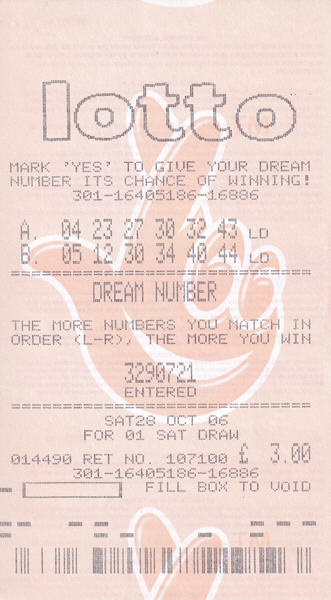

Your hopes of winning the jackpot prize were dashed if the first digit of your Dream Number was not the first digit drawn by Camelot. To win a prize, you had to match the digits one for one from left to right as they were drawn.
The table below shows the prize structure and likelihood of success in each category using odds and probability[15].
| Match the Dream Number digits in order from left to right | Outcomes | Odds in favour | Probability | Prize | ||
|---|---|---|---|---|---|---|
| Favourable | Unfavourable | Number | % | |||
| No digits | 9,000,000 | 1,000,000 | 9 : 1 | 0.9000 | 90.00000% | None |
| First digit | 900,000 | 9,100,000 | 1 : 10.1 | 0.0900 | 9.00000% | £2 |
| First 2 digits | 90,000 | 9,910,000 | 1 : 110.1 | 0.0090 | 0.90000% | £10 |
| First 3 digits | 9,000 | 9,991,000 | 1 : 1,110.1 | 9.000 × 10⁻⁴ | 0.09000% | £100 |
| First 4 digits | 900 | 9,999,100 | 1 : 11,110.1 | 9.000 × 10⁻⁵ | 0.00900% | £500 |
| First 5 digits | 90 | 9,999,910 | 1 : 111,110.1 | 9.000 × 10⁻⁶ | 0.00090% | £5,000 |
| First 6 digits | 9 | 9,999,991 | 1 : 1,111,110.1 | 9.000 × 10⁻⁷ | 0.00009% | £50,000 |
| All 7 digits | 1 | 9,999,999 | 1 : 9,999,999 | 1.000 × 10⁻⁷ | 0.00001% | £500,000 |
| Total: | 10,000,000 | 1 | 100% | |||
Dream Number was an example of the Standard Numbers game.
Adding Raffles
Raffles produce guaranteed winners in each draw, unlike Lotto, which may have rollovers. Camelot introduced raffles in
- Game 2 of the Big Draws (2000 and 2001) and Christmas Millionaire Maker (2001, 2002 and 2003);
- Euromillions (Millionaire Raffle, renamed Millionaire Maker later) and
- Lotto.
This action ensured that some players were seen to receive jackpot-style prizes to make those games seem more rewarding in the public eye and foster continued participation.
A later article will discuss the Lotto Raffle in depth.
Changing the Prize Structure
| Game | Introduced | Remarks |
|---|---|---|
| Lotto | 19 Nov 1994 | First draw of the National Lottery’s online game. |
| 23 Mar 1996 | Debut of Lucky Dips. | |
| 5 Feb 1997 | Wednesday draws began. | |
| 15 Nov 2000 | Lottery Extra became an optional supplementary game to award high jackpots for £1 extra per board. | |
| 18 May 2002 | Rebranding of the National Lottery took effect with the games renamed Lotto and Lotto Extra with three additional jackpot-only draws to supplement the main draw. | |
| 8 Jul 2006 | Lotto Extra game retired. | |
| 15 Jul 2006 | Dream Number replaced Lotto Extra as Lotto’s optional supplementary game to fund the 2012 Olympic Games in London. | |
| 9 Feb 2011 | The last Dream Number game took place. | |
| 13 Feb 2011 | Lotto Plus 5 began. It was identical to Lotto but had fixed prizes. This optional supplementary game was played on days other than Wednesdays and Saturdays. | |
| 1 Oct 2013 | The last game of Lotto Plus 5 took place. | |
| 5 Oct 2013 | The New Dawn for Lotto heralded changes. i.e. The price of a board doubled from £1 to £2, and raffle prizes of £20,000 were introduced. Occasionally, there were raffle prizes of £1 million. Lotto adopted 59 balls instead of 49 on Saturday, 10 October 2015 (draw 2066) and abandoned the raffle prizes entirely on Wednesday, 21 November 2018 (draw 2391) – enhanced Lotto. | |
| Thunderball | 12 Jun 1999 | The National Lottery introduced the first game of Thunderball, a game in two parts, firstly choosing five from 34 main balls and then one from 14 Thunderballs. The chance of winning the top prize was 1 in (34C5 × 14C1). i.e. 1 in 3,895,584. The cost of entry was £1 per board. There were fixed prizes spread over eight tiers with a maximum of £250,000 for matching five main balls and the Thunderball. |
| 23 Oct 2002 | Wednesday’s draws began with draw 177. | |
| 12 May 2010 | Thunderball had a significant revamp with draw 965. Now, there were 39 main balls instead of 34, the top prize doubled to £500,000, and a minor prize of £3 was awarded for matching only the Thunderball. The cost of entry remained £1 per board. There were fixed prizes spread over nine tiers. The chance of winning the top prize became 1 in (39C5 × 14C1). i.e. 1 in 8,060,598. | |
| 14 May 2010 | First Friday Thunderball draw (966). | |
| Lotto Hotpicks | 10 Jul 2002 | The National Lottery introduced Lotto Hotpicks as an independent game with fixed prizes and as a companion of Lotto, sharing the same main numbers but with a different prize structure and rules. It began alongside Lotto draw 683 and was designed to compete with bookmakers, who used lottery results for their sideshow games. Each board cost £1. There were three distinct games to play – Pick 2 of 2, Pick 3 of 3 and Pick 4 of 4. Prizes were fixed at £40, £450 and £7,000. |
| 26 Oct 2005 | Two new prize tiers were added. i.e. Pick 1 of 1 and Pick 5 of 5 with prizes of £5 and £130,000. | |
| Euromillions | 13 Feb 2004 | Camelot joined European lotteries in France and Spain to provide Euromillions. This game offered huge jackpots for an initial fee of £1.50 per board. In October that year, lotteries in Austria, Belgium, Ireland, Luxembourg, Portugal, and Switzerland joined too. Initially, players had to choose five balls from 50 and two Lucky Stars from 9 to win the jackpot. There were 12 prize tiers. |
| 7 Nov 2009 | The price of a board rose to £2 due to a prevailing poor £ / € exchange rate against the £. To compensate, UK players gained entry to a new Millionaire Raffle with one guaranteed prize of £1 million. Also, new rollover rules, including a cap on the jackpot prize pool of €185 million, were introduced. | |
| 10 May 2011 | Draws began on Tuesdays. Two more Lucky Stars were added, making 11, and a new prize for players matching just two main balls. Now, there were 13 prize tiers. | |
| 12 Jan 2012 | The minimum jackpot prize rose from €15 million to €17 million. | |
| 27 Jul 2012 | One hundred raffle prizes of £1 million were given during the London 2012 Olympic Games to thank UK players for their help in funding the games. | |
| 31 May 2013 | The raffle prize of £12,000,000 was paid in monthly instalments of £1,000,000 for one year. | |
| 31 Oct 2014 | The first top-up prize was offered to incentivise players. i.e. Mega-Friday additional prize: A PRIVATE ISLAND GETAWAY | |
| Since 2007 | There have been several Event Draws and Super Draws with guaranteed amounts. e.g. €100 million. They differ in what happens to the jackpot if there are no outright winners. The jackpot rolls down to the lower tiers for an Event Draw but rolls over to the next draw in the case of a Super Draw. |
Providing other channels to buy tickets
| Medium | Method | Remarks |
|---|---|---|
| In-store – pay the retailer | Play Slip | Select your numbers by placing marks in small rectangular boxes, arranged in boards – or pick Lucky Dip. There are 7 boards, and you can play the same numbers for up to 8 weeks in Wednesday or Saturday draws, or both. This was the original method of entry; it is anonymous. |
| Lucky Dip® | The computer picks sets of numbers randomly for you – either by marking a play slip, or by asking the retailer for a Lucky Dip. | |
| Fast Pay card | Use a special, wallet-sized card to record your personal choices and preferences for a speedy purchase. | |
| Manual Entry | Ask the retailer to enter your choices directly via the keypad on the special terminal – number by number, one at a time. This method tends to be actively discouraged, since there are quicker, less tedious and less error prone methods available. i.e. the three listed above. | |
| National Lottery Account Holder (on-line) | On-line form | Enter your selection of numbers, frequency of play and number of weeks on a form that is part of a National Lottery web page. More than one board can be selected. |
| Smartphone | A free App is available on Android and Apple iPhone platforms, which directs the player to the mobile version of the National Lottery website to facilitate play. | |
| Direct Debit | Play sets of numbers regularly by Direct Debit from your bank account for an extended period. Previously, this was known as a Subscription. You set it up on-line. |
Other games have similar arrangements. The number of boards on a play slip and the days of the week such games are played vary from game to game
Notes
- [1] The figure does not include Big Draw 2000 and 2001, and Christmas Millionaire Makers 2001, 2002 and 2003. They occurred at New Year’s and Christmas and would not appear on the figure at the resolution used.
- [2] The minimum age was raised to 18 years, effective from 22 April 2021. The Isle of Man residents became eligible to purchase tickets on 2 December 1999 at the behest of Tynwald, the Manx Parliament.
- [3] We looked closely at the relationship between sales and prizes earlier[Example] in part 1.
- [4] In draw 119, eighteen winners received £555,556, sharing a jackpot of £10 million from sales of £27,707,786.
- [5] There were precedents. State-run lotteries were commonplace in the 18th century. There were vigorous attempts by the authorities to stamp out illegal operations. The lotteries were publicised well with specially printed notices and handbills. Although hardly any changes were made to the cumbersome method of drawing the winners, many lotteries had an atmosphere of great excitement. Other, much smaller lotteries would often run alongside them illegally as side-shows.
By 1792, the net annual profit from state-run lotteries had reached £300,000, but there was a growing belief that they were detrimental to individuals and society. The Grand Jury at the Old Bailey went so far as to issue a statement expressing its concerns about the link between gambling on the lottery and cases of fraud and theft.
Despite the moral and social objections, the biggest threat came from the insurance schemes that had sprung up alongside the lottery. Lotteries had fuelled gambling, and gains outweighed losses only for the fortunate few. In many spheres of life, it was possible to insure against loss, so it seemed perfectly natural to apply the same principles to the lottery.
The schemes used the fact that lottery draws were spread over many days. Insurance agents not affiliated with the state-run lotteries published books of winning numbers. For a small sum, you could insure against a number being drawn as a blank on a given day without participating in the lottery. Often, insurance sellers sold tickets in small illegal lotteries called Little Goes. Worse still, there were cases in which “winning” tickets were re-sold. As forgeries, they were worthless to any hapless buyer.
These activities deprived the state of revenue by diverting money from the lottery. The organisers took remedial action to remedy the situation by shortening each draw period, thus depriving the insurance agents of lists of numbers and prizes. However, it was too late; irreparable damage had been done to the reputation of lotteries.
Read: Early Lotteries in England – a national love affair for more information. - [6] To illustrate the counting process, suppose a player chooses 5 and 17 for Pick 2 of 2. The count will only be increased if the set {5, 17} appears in one of the 49C6 or 59C6 combinations. i.e. if {5, 17} is a subset.
A set A is a subset of another set B if A ∪ B = B.
Venn diagram of set A as a subset of set B.
A ⊂ B - [7] Microsoft Excel includes the hypergeometric distribution function HYPGEOMDIST(x, n, M, N).
To calculate the probability of matching Pick 2 of 2 in Lotto Hotpicks played with 49 balls, enter =HYPGEOMDIST(2, 2, 6, 49) as a formula in a worksheet cell. - [8] My calculations of the odds in favour differ slightly from the official National Lottery website.
- [9] On 6 July 2005, the International Olympic Committee awarded the right to hold the 2012 Olympic Games to London. Subsequently, the National Lottery provided funding worth £2.2 billion for the London 2012 Olympic and Paralympic Games.
- [10] This game evolved as Dream Number; it had a finite lifetime. 28p from each £1 board went directly into a fund for the Olympics instead of the general pool for Good Causes.
- [11] Players living in Andorra, the Isle of Man, Liechtenstein and Monaco are eligible too, along with French overseas territories and collectivities. e.g. Residents of the archipelago, Saint Pierre and Miquelon – off the coast of Newfoundland, Canada – should be eligible (unconfirmed).
- [12] Buying a single Euromillions board gave one chance in 116,531,800 of winning the jackpot; for Lotto, there was one chance in 13,983,816.
- [13] Source: National Lottery Commission.
- [14] Source: Individual Euromillions pages of the Merseyworld Lottery, compiled by Richard K Lloyd – sales converted from € to £, using the prevailing exchange rate.
- [15] The odds in favour are expressed as the ratio of favourable and unfavourable outcomes. A colon (:) separates the two quantities to signify the ratio. e.g. 9 : 1 – read as 9 to 1.
The odds against are the reciprocal of the odds in favour. e.g. 1 : 9.
The probability of a favourable event occurring is expressed as a number between 0 and 1, or sometimes as a percentage between 0% and 100% since many people find it irritating to compare decimal quantities. You can calculate the probability by forming the quotient of favourable and total outcomes. The result is always between 0 and 1; values closer to 1 are more likely to occur and less likely closer to zero the probability comes.
Revision date: 2 May 2024