The Lotto Raffle
From 2013 to 2018, Camelot tried to turn around declining sales by adding a raffle to Lotto, thereby increasing the revenue of Good Causes.
A raffle is a type of lottery. i.e. a game of chance, not skill, in which buyers of tickets receive prizes chosen by lot. In the way it draws lots, a raffle guarantees participants will win prizes.
| AQUA00842019 | BLUE02951685 | GOLD00386757 | GREY02475575 |
| JADE03239462 | LIME00416535 | NAVY01175584 | PINK04972178 |
| PLUM00599639 | ROSE00568062 | RUBY00302224 | TEAL03205417 |
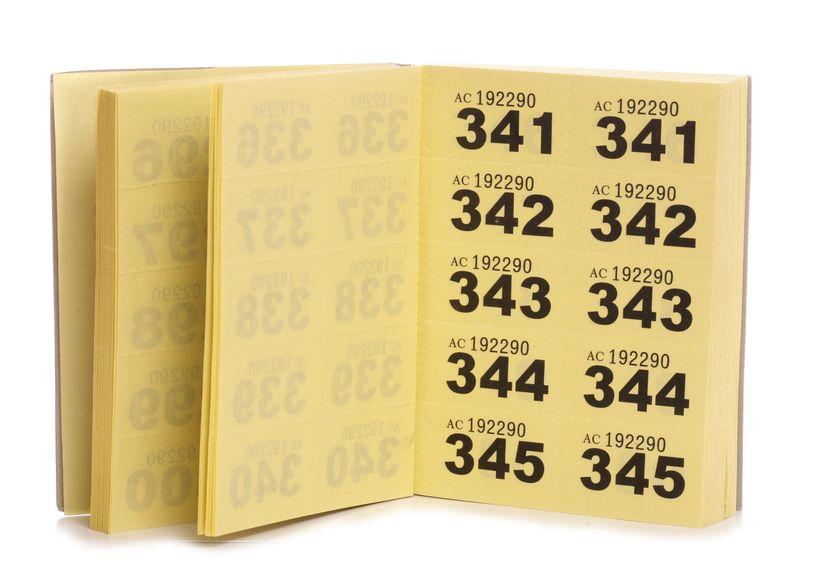
Backed by clever computer software and a national network, the Lotto Raffle was a sophisticated electronic version of a simple raffle called a tombola that uses books of coloured cloakroom tickets at village fêtes and coffee mornings.

Courtesy: Kullez from Hjärup, Sweden, CC BY 2.0, via Wikimedia Commons.
.jpg)
Unlike a tombola, the Lotto Raffle operated nationally with minimum human intervention alongside Lotto. Buyers acquired one raffle ticket for every Lotto board with no say in the ticket number, which was allocated automatically by the software.
Estimated reading time: 22 minutes
Background
Early Years of the National Lottery
The National Lottery began with a single game, known originally as the Online Game. Later, in 2002, it was renamed as Lotto.
The basic unit of play was a board, which cost £1 and consisted of six unique numbers chosen from 49.
In each drawing, the pattern remained the same. A mechanism withdrew seven agitated balls from a drum in full view of a TV audience – the first six comprised the main balls, and the seventh, the bonus ball.
There was a simple prize structure of five tiers, ranging from a guaranteed minimum of £10 to a million pounds or more. Typically, matching five main balls and the bonus paid a handsome prize of around £100,000. The exact amounts of four of the five prize tiers depended on a set proportion of ticket sales. i.e. the prizes were pari-mutuel. The game caught the imagination of the playing public, who played consistently overall.
The first few years after the National Lottery was launched in 1994, things settled as the euphoria subsided when it dawned on many players that they had been wildly overoptimistic about their chances of fortune.
The National Lottery enterprise did not remain static but evolved as Camelot introduced several games to diversify its portfolio and entice new players; some were successful, others not.
Family of Games
| Game | Began | Ended | Remarks |
|---|---|---|---|
| Lotto | 19/11/1994 | – | The original flagship game – 7 numbers drawn from 49; re-branded as Lotto in 2002. Usually, the jackpot exceeds £1 million.
The player picks 6 balls from 49, hoping to match the six main balls drawn.
|
| Thunderball | 12/06/1999 | – | Five numbers drawn from 34 originally, plus 1 from 14 (the Thunderball). Draws were made on Saturdays initially. The prizes were fixed and spread over 8 tiers. Maximum prize : £250,000. Players choose 5 main balls and one Thunderball to win a prize. |
| Lotto Hotpicks | 10/07/2002 | – | Lotto Hotpicks is an independent game with fixed prizes. It is a companion of Lotto, sharing the same main numbers, but with a different prize structure and rules. Initially, there were three distinct games to play – Pick 2 of 2, Pick 3 of 3, and Pick 4 of 4. Lotto Hotpicks was introduced to counter a threat from UK bookmakers, who had piggy-backed Lotto to offer higher prizes in the lower tiers, particularly Match 3, 4 and 5. The alternatives used the numbers drawn in UK and Irish lotteries, but applied different rules. They had different odds of winning. Similarities were superficial, not like for like, making exact comparisons difficult. |
| Euromillions | 13/02/2004 | – | Pan-European game with huge jackpots. Tickets cost £1.50 each. Players choose 5 main balls from 50, and two Lucky Stars from 9 to match those drawn to win prizes in 12 tiers. |
| Daily Play | 22/09/2003 | 06/05/2011 | Each board cost £1. Players chose 7 numbers from 27 to win prizes in 5 tiers. Matching none with the seven numbers drawn won a free Lucky Dip. There were fixed cash prizes for matching 4, 5, 6 and 7 numbers with a maximum of £30,000. Daily Play was not played on Sundays or Christmas Day. Altogether, 2,380 games were played before the game ended. |
| Dream Number | 15/07/2006 | 09/02/2011 | The Dream Number game supported the 2012 Olympic and Paralympic Games in London with 478 games. Each Dream Number consisted of seven digits. There were fixed prizes with a maximum of £500,000. Boards were bundled with Lotto for an optional additional fee of £1. This game was unique in that the order in which the numbers were drawn mattered. |
| Lotto Extra | 15/11/2000 | 08/07/2006 | Lotto Extra was a jackpot only game derived from Lotto with jackpots rising from £1 million. It was based on 6 main numbers. To take part, players bought a ticket in conjunction with Lotto at an additional cost of £1 per board. |
| Lotto Plus 5 | 13/02/2011 | 01/10/2013 | Essentially, Lotto Plus 5 was identical to Lotto, but with fixed prizes. It was played in conjunction with Lotto with draws on days other than Wednesdays and Saturdays. Plus 5 had a jackpot of £250,000 and ended just before the New Dawn for Lotto after 688 draws. |
| Lotto Raffle | 05/10/2013 | 17/11/2018 | There were five tiers of prizes eventually, ranging from £20,000 to £1,000,000 with guaranteed winners. |
| Big Draw 2000 and 2001 | Nov 1999 Dec 2000 | One-offs | Each consisted of 2 distinct games drawn at New Year. Tickets were £5 each. |
| Christmas Millionaire Maker 2001 to 2003 | Nov 2001 Nov 2002 Nov 2003 | One-offs | Similar to the Big Draw, but took place on Christmas Eve. In these games, the numbers drawn were years. e.g. 1999. |
Timeline of Games

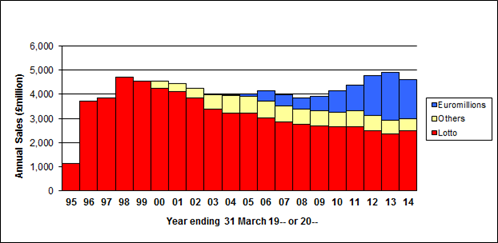
Sales Profile
From sales, evidence suggests that some new games detracted players’ attention from the flagship game of Lotto. To some extent, Lotto was neglected, while others were developed.
A New Dawn for Lotto
Lotto Draw 1856, held on Saturday, 5 October 2013, heralded a New Dawn for Lotto.
- The price of a single Lotto board doubled to £2 – the board being the unit of play.
- Matching three main balls resulted in a prize of £25, up from £10.
- Raffle prizes of £20,000 were introduced. Routinely, fifty such prizes would be offered in each draw. However, the rules permitted some variation in the number and value of the prizes by prior notification to the public through advertising.
- There would be bigger jackpots[2].
Two years earlier, Camelot had recognised that Lotto jackpots were declining in size and impact. If you recall, historically, high jackpots increase ticket sales, and higher ticket sales generate significantly bigger jackpots in a seemingly virtuous feedback loop.
Read: The relationship between jackpots and sales to learn more.
Then, Camelot’s response was to increase the rollover limit from three to four, beginning with Draw 1580 on Saturday, 12 February 2011. Soon afterwards, one lucky winner scooped an impactful £17,799,986 in a triple rollover on Wednesday, 9 March 2011; ticket sales rose.
We had to wait until Draw 1750 on 29 September 2012 for the first quadruple rollover, with a jackpot pool of £19,549,950 shared among five winners, giving £3,909,990 each. Estimates[3] of tickets sold lie between 38,267,404 and 38,267,424 – a far cry from the maximum of 127 million recorded in January 1996.
Soon after the New Dawn, there was a second quadruple rollover in Draw 1882. However, there were no winners of the Match 6 category. For the first time, the jackpot of £13,095,305 was added to the Match 5 plus Bonus pool and divided among 23 winners, giving them £585,956 each. Sales were estimated to be £41,555,124, equivalent to 20,777,562 boards.
The New Dawn began as a Superdraw with a guaranteed jackpot of £10 million and 1,000 raffle prizes of £20,000. To emphasise the changes, the draw for next Saturday followed the same pattern. Each jackpot had a single winner. The re-launch of Lotto had been successful.
Camelot’s Perspective
Camelot did not revamp Lotto purely out of a sense of altruism. There was a sound commercial imperative.
Although the Lotto remained the flagship game of the National Lottery, the jackpots had become less impressive as sales declined in the long term. However, Euromillions had begun to capture the British public’s imagination with several spectacular jackpots, threatening Lotto’s dominance. It was time to act to restore Lotto’s fortunes.
Read: About Euromillions to learn more.
Bear in mind that the promoters of Lotto were striving to maximise the jackpot and simultaneously encourage players to play Lotto week in and week out. Although a large jackpot may generate a temporary increase in sales to benefit Good Causes, jackpots are challenging to win nevertheless.
The trend matters more than a single event. Handing out many small but significant prizes that would always be won helps keep the dream of winning a jackpot alive; this motivated the Lotto Raffle.
The Lotto Raffle
Background
A raffle operated alongside each Lotto draw between Draw 1856 and Draw 2390 for 535 draws – 210 draws employed 49 balls (original Lotto), and 325 draws used 59 balls (enhanced Lotto).
Each board bought automatically secured one raffle ticket. Simultaneously, both remained active until the board expired and participated in the same draws.
The tickets issued by Camelot mimicked the familiar coloured cloakroom tickets used at charity fairs and fêtes to raffle small prizes. However, tickets for the Lotto raffle were managed by Camelot’s computer system and were not torn out of books of cloakroom tickets. To extend the analogy, Lottery raffle tickets were identified by combining a colour with an eight-digit number, e.g. LIME 2790 1400.
Twelve colours were used: aqua, blue, gold, grey, jade, lime, navy, pink, plum, rose, ruby, and teal. Eight digits provided a range of 100 million – from 0 to 99,999,999. Therefore, an ample supply of 1,200 million unique raffle tickets was available to support ticket sales[4] almost indefinitely.
Possible mode of operation
If we imagine the operation of the Lotto draw, the following sequence of events might represent what happens under the control of Camelot’s computer system.
- Camelot’s computer selects a raffle ticket randomly and removes it from the unused pool whenever a player buys a Lotto board. The raffle ticket’s identification number obeys the rules described above.
- The ticket is marked as “in use” and tied to the Lotto board so that it participates in the same draws. It joins another much smaller pool of used numbers, preventing other players from sharing the same raffle ticket.
- The raffle ticket is returned to the unused pool for reuse when the board has finished.
- During the Lotto draw, Camelot randomly picks the quota of winning prizes from tickets in the used pool.
The numbers on the raffle tickets bear no relation to the Lotto balls. Unless you opt for a Lucky Dip, you can pick your numbers when you buy a Lotto board. However, you cannot control the identification number given to the accompanying raffle ticket.
Read: The raffle in Big Draw 2000 – game 2 to learn more and gain insights.
The Early Lotto Raffle in practice
Usually, 50 raffle prizes of £20,000 were available per standard draw, rising by 50 additional prizes for each successive rollover up to a maximum[5] of 250. However, Camelot could offer more prizes on special occasions[6].
| Type of Lotto Draw | No. of Raffle Prizes | Prize Pool |
|---|---|---|
| Standard | 50 | £1,000,000 |
| First rollover after a standard draw | 100 | £2,000,000 |
| Second rollover after a standard draw | 150 | £3,000,000 |
| Third rollover after a standard draw | 200 | £4,000,000 |
| Fourth (and final) rollover after a standard draw | 250 | £5,000,000 |
But Camelot quickly abandoned this escalating prize structure when they realised it was unsustainable. It ended with the draw celebrating the twentieth anniversary of the National Lottery. This draw (Draw 1974), which took place on 22 November 2014, offered two tiers of raffle prizes to conclude:
- twenty £1 million raffle prizes and
- fifty £20,000 raffle prizes.
After that, there were usually fifty raffle prizes of £20,000 per draw until the last Lotto draw (Draw 2065) using 49 balls on Wednesday, 7 October 2015. Any exceptions are shown below.
| Draw | Date | Prizes of £20,000 | Prizes of £1,000,000 |
|---|---|---|---|
| 1983 | 24 Dec 2014 | 500 | – |
| 1998 | 14 Feb 2015 | 50 | 10 |
| 2021 | 6 May 2015 | 50 | 1 |
| 2023 | 13 May 2015 | 50 | 1 |
| 2025 | 20 May 2015 | 50 | 1 |
| 2027 | 27 May 2015 | 50 | 1 |
| 2044 | 25 Jul 2015 | 50 | 7 |
For a standard draw, you had a better chance of winning a raffle prize on Wednesday than on Saturday – approximately 50 in 8,000,000 rather than 50 in 16,000,000.
Raffles supplant Superdraws
Before the New Dawn, having a Superdraw with a guaranteed jackpot on special occasions was standard practice. However, there might be no jackpot winners, particularly on an anniversary or other significant occasion when it would have gained attention.
Using the raffle as an alternative to a Superdraw as a marketing ploy to launch the raffle and promote Lotto ensured that there would be at least 20 winners of £1 million on the night with the prospect of a jackpot winner, too.
Camelot continued to give the raffle prominence; there were no Superdraws between Draw 1859 and Draw 2400.
Funding the Raffle
Camelot responded to the long-term decline in Lotto sales by allocating a higher proportion of the prize fund to the jackpot and raising the Match 3 prize from £10 to £25.
With the New Dawn, 47.5% of the price of each board went to pay prizes instead of 45%.
| Allocated to | Percentage | Amount |
|---|---|---|
| Prizes | 47.5% | 95p |
| Good Causes | 28% | 56p |
| Lottery Duty to the Exchequer | 12% | 24p |
| Commission to retailers | 5% | 10p |
| Operating costs | ~4% | ~8p |
| Operator’s profit | 0.3% to 0.5% | 0.6p to 1p |
| Retained for other use | ~3% | ~6p |
| Total – the price of a single Lotto board | 100% | £2.00 |
Also, the Match 4 prize pool was increased slightly to boost the size of the Match 4 prizes. This subtle change increased the average prize by about 50% and gave the impression that winners were getting more out of the game, given that Match 3 and Match 4 together account regularly for more than 99.8% of all winners.
The resulting prize fund was split into two.
- 42.47% of sales went to pay prizes in the five tiers – Match 3, 4, 5, 5+ and Match 6.
- 5.03% of sales went to pay the Lotto Raffle prizes.
The following table shows how the remainder of the sales was broken down and distributed.
| Tier | Pools Fund Allocation | Remarks |
|---|---|---|
| Match 6 | 66.4% | Any jackpot from a previous draw will be added to this sum. Also, the Match 5+ pool will be added if there are no winners of that tier. Then, the pool is divided equally among the winners if there are any; otherwise, it will be rolled over to the next draw unless this is the final consecutive rollover that is allowed. After that, it will be added to the Match 5+ pool to be divided among the winners of that tier. |
| Match 5+ | 5.3% | This pool will include the Match 6 pool if there are no winners of the jackpot when the limit on consecutive rollovers has been reached. The pool is divided equally among the winners if there are any; otherwise, it will be added to the Match 5 tier below if (and only if) the Match 6 pool has cascaded down here. |
| Match 5 | 4.5% | The pool is divided equally among the winners if there are any; otherwise, it will be added to the tier below – Match 4. |
| Match 4 | 23.8% | The pool is divided equally among the winners if there are any; otherwise, it will be added to the tier below – Match 3. |
| Match 3 | Exceptional case | If there are no Match 4 winners, the Match 4 pool will be divided among the Match 3 winners to raise the prize above its basic level of £25. |
The rules governing how the prizes in the five tiers are calculated might seem complicated and unwieldy initially, but there are some general principles at work. Considering ordinary circumstances and exceptions helps to simplify matters.
- Each prize pool is shared equally between the winners of that tier, but other rules apply if there are no winners.
- Some rules are superimposed on others to provide contingencies for infrequent, rare or sporadic events. They are concerned with what should happen whenever tiers have no prize winners. In most cases, the prize pool will cascade down the hierarchy to be added to the next lower tier for distribution. Match 6 is uppermost in the hierarchy, followed by Match 5+, then Match 5, Match 4 and finally Match 3.
- In any event, Match 3 prizes take priority and have the first claim on the fund from 42.47% of sales.
- Once Match 3 prizes have been paid, there are usually sufficient funds to pay prizes in the higher tiers. What remains is called the Pools Fund and is distributed accordingly.
Paying for the Raffle prizes
Sales of £19,880,716 are needed to fund 50 raffle prizes of £20,000, with funding set at 5.03% of sales. In the 210 draws between the New Dawn and draw 2065, sales of Lotto boards exceeded this amount on Wednesdays on 13 occasions only – see the following table.
| Draw | Draw Date | Estimated Sales | Remarks |
|---|---|---|---|
| 1873 | 4 Dec 2013 | £21,470,444 | Double rollover |
| 1877 | 18 Dec 2013 | £21,291,084 | Double rollover |
| 1879 | 25 Dec 2013 | £36,503,438 | Single rollover with 500 raffle prizes |
| 1881 | 1 Jan 2014 | £25,737,350 | Triple rollover |
| 1955 | 17 Sep 2014 | £25,884,244 | Quadruple rollover |
| 1981 | 17 Dec 2014 | £24,789,238 | Quadruple rollover |
| 1983 | 24 Dec 2014 | £32,654,368 | Single rollover with 500 raffle prizes |
| 1985 | 31 Dec 2014 | £23,739,124 | Single rollover |
| 1987 | 7 Jan 2015 | £21,794,582 | Triple rollover |
| 1991 | 21 Jan 2015 | £20,070,164 | Double rollover |
| 1993 | 28 Jan 2015 | £24,995,306 | Quadruple rollover |
| 2027 | 27 May 2015 | £23,808,282 | Quadruple rollover |
| 2033 | 17 Jun 2015 | £25,365,736 | Quadruple rollover |
Typically, Wednesday sales were insufficient to fund the usual quota of 50 raffle prizes. However, this lack was more than compensated by the surplus provided by Saturday sales. Taken together, on average, Wednesday and Saturday sales raised more than £2.5 million per week to fund the raffle prizes, which helped the raffle prizes be self-funding in line with rules stipulated by the regulator.
Any money left over once the raffle prizes had been settled for that draw was paid into a Reserve Fund, enabling the payment of prizes in subsequent draws with insufficient sales.
Uses of the Reserve Fund
- funding additional raffle prizes;
- increasing a Lotto or raffle prize;
- promotion of Lotto.
Thus, the prize structure was flexible, which Camelot could employ to pursue higher returns for the Good Causes.
Prize Capping
What would happen if the prize fund were too small to pay prizes?
Prize Capping would be invoked if the fund derived from 42.47% of sales did not provide enough money to pay £25 to winners in every category.
In that case, the Prize Capped Fund would be divided among the tiers differently, essentially maintaining the general principles outlined earlier. If necessary, the Reserve Fund would meet the cost of paying Match 3 winners £25 each.
| Tier | Capped Pools Fund Allocation |
|---|---|
| Match 6 | 31.9% |
| Match 5+ | 2.5% |
| Match 5 | 2.2% |
| Match 4 | 11.4% |
| Match 3 | 52.0% |
| Total: | 100% |
The National Lottery website clarified that prize capping was expected to occur rarely, if at all. However, I was not convinced. It could have happened! Here is my reasoning.
If F represents the prize fund and S, the sales, then
$$ \begin{equation}F = \frac{42.47 \times S}{100} \end{equation} $$Suppose that n represents algebraically the number of Match 3 winners that would absorb the entire prize fund. Recalling that each Match 3 winner collects a prize of £25 gives a value for n.
$$ \begin{align*}n& = \frac{F}{25}\\ \\&=\frac{42.47 \times S}{25 \times 100}\\ \\&=\frac{1.6988 \times S}{100} \end{align*} $$We can calculate the threshold for Price Capping by recalling that the total number of boards sold is half the sales since each board costs £2. Notice that the sales S cancel out in the fraction.
$$ \begin{align*}Success \thinspace rate \thinspace for \thinspace Match \thinspace 3& = \frac{Number \thinspace of \thinspace Match \thinspace 3 \thinspace winners}{Number \thinspace of \thinspace \thinspace Boards \thinspace sold} \times 100 \%\\ \\&=\frac{1.6988 \times S}{100} \times \frac{2}{S} \%\\ \\&=3.3976 \% \end{align*} $$In this scheme, Prize Capping will be triggered if the number of Match 3 winners exceeds roughly 3.40% of the Lotto boards sold.
Before enhanced Lotto began, the draw nearest to 3.40% was Draw 1945, held on Wednesday, 13 August 2014. Here, Match 3 winners accounted for 2.84% of sales.
| Prize Tier | Winners | Prizes | Prize Pool |
|---|---|---|---|
| Match 3 | 219,273 | £25 | £5,481,825 |
| Match 4 | 16,593 | £15 | £248,895 |
| Match 5 | 464 | £105 | £48,720 |
| Match 5+ | 7 | £8,211 | £57,477 |
| Match 6 | 2 | £360,076 | £720,152 |
| Sub-total: | 236,339 | – | £6,557,069 |
| Raffle | 50 | £20,000 | £1,000,000 |
| Total: | 236,389 | – | £7,557,069 |
| Balls: 5, 9, 11, 20, 23, 30, bonus 45 | |||
| Sales: £15,461,248 (estimated) | |||
| Boards: 7,730,624 | Success rate: 3.06% | ||
The prizes were woefully small. The Match 4 prize fell below the Match 3! Effectively, the prize structure collapsed under the sheer number of Match 3 winners.
Looking at the numbers drawn above reveals the probable cause. The main balls are all below 31, the maximum number of days in a month—think birthdays! Other draws exhibited a similar effect.
| Draw | Date | Balls | Estimated Sales | Success Rate | Match 4 Prize |
|---|---|---|---|---|---|
| 1918 | 10 May 2014 | 3, 5, 8, 10, 16, 17 (46) | £33,964,922 | 2.82% | £25 |
| 1930 | 21 Jun 2014 | 3, 7, 13, 17, 27, 40 (19) | £31,887,174 | 2.71% | £28 |
| 1987 | 7 Jan 2015 | 4, 5, 10, 12, 20, 23 (24) | £21,794,582 | 2.73% | £28 |
| 2041 | 15 Jul 2015 | 4, 7, 14, 21, 22, 29 (25) | £15,433,184 | 2.90% | £21 |
Prize Capping was never exercised when Lotto used 49 balls.
The Raffle after Enhanced Lotto
The Lotto game changed with Draw 2066 on Saturday, 10 October 2015. From this date, Lotto used 59 balls instead of the familiar 49, which significantly affected the chances of winning.
| Category | Combinations | Probability of Achievement (%) |
|---|---|---|
| No Match | 40,175,590 | 89.1652% |
| Match 2 | 4,392,375 | 9.74838% |
| Match 3 | 468,520 | 1.03983% |
| Match 4 | 20,670 | 4.58747 × 10⁻² % |
| Match 5 | 312 | 6.92449 × 10⁻⁴ % |
| Match 5+ | 6 | 1.33163 × 10⁻⁵ % |
| Match 6 | 1 | 2.21939 × 10⁻⁶ % |
| Grand Total: | 45,057,474 | 100% |
We shall refer to the 59-ball game as enhanced Lotto to distinguish the versions.
A new prize category was introduced for matching two of the main balls – Match 2. Initially, the prize had no cash value; winners were given free Lucky Dips in a future draw. Some people dispute whether this qualified as a prize. Others saw it as little more than a sop to players to give the illusion of a better chance of winning when the odds of winning a cash prize had worsened.
The Lotto Raffle continued with changes to its prize structure. A lower tier of 20 prizes of £20,000 and a single prize of £1,000,000 became the norm. There were variations to allow Camelot to promote the game. The Raffle continued until Draw 2390 on Saturday, 17 November 2018, when it ended.
| Draw | Date | Prizes of £20,000 | Prizes of £1,000,000 |
|---|---|---|---|
| 2066 | 10 October 2015 | 20 | 25 |
| 2078 | 21 November 2015 | 20 | 10 |
| 2088 | 26 December 2015 | 20 | 5 |
| 2094 | 16 January 2016 | 20 | 5 |
| 2118 | 9 April 2016 | 20 | 10 |
| 2125 | 4 May 2016 | 20 | 2 |
| 2126 | 7 May 2016 | 20 | 2 |
| 2127 | 11 May 2016 | 20 | 2 |
| 2128 | 14 May 2016 | 20 | 2 |
| 2129 | 18 May 2016 | 20 | 2 |
| 2130 | 21 May 2016 | 20 | 2 |
| 2131 | 25 May 2016 | 20 | 2 |
| 2132 | 28 May 2016 | 20 | 2 |
| 2192 | 24 December 2016 | 220 | 1 |
| 2194 | 31 December 2016 | 120 | 1 |
| 2296 | 23 December 2017 | 220 | 1 |
| Totals: | 820 | 74 | |
| £16,400,000 | £74,000,000 |
Lotto Extra Chance
In April and May 2016, the National Lottery offered Extra Chances for its Lotto Raffle. Players who had bought tickets in a few draws qualified for entry into this supplementary game. Online players took part automatically; retail players had to enter the 19-digit ID number of their qualifying ticket in a text box on the webpage lottopromo.national-lottery.co.uk through the internet.
There were ten Extra Chances of £20,000 per week for eight weeks and a final Extra Chance of £1,000,000 for tickets bought in June on 4 July.
| Draw | Date | Raffle Prize | Qualifying Dates | |
|---|---|---|---|---|
| £20,000 | £1,000,000 | |||
| 1 | 11 Apr 2016 | 9 | – | 6 Apr 2016, or 9 Apr 2016 |
| 2 | 18 Apr 2016 | 10 | – | 13 Apr 2016, or 16 Apr 2016 |
| 3 | 25 Apr 2016 | 10 | – | 20 Apr 2016, or 23 Apr 2016 |
| 4 | 3 May 2016 | 10 | – | 27 Apr 2016, or 30 Apr 2016 |
| 5 | 9 May 2016 | 10 | – | 4 May 2016, or 7 May 2016 |
| 6 | 16 May 2016 | 9 | – | 11 May 2016, or 14 May 2016 |
| 7 | 23 May 2016 | 10 | – | 18 May 2016, or 21 May 2016 |
| 8 | 31 May 2016 | 10 | – | 25 May 2016, or 28 May 2016 |
| 9 | 4 Jul 2016 | – | 1 | Any Lotto draw in June 2016 |
Interestingly, two draws had nine instead of ten winners; presumably, two retail customers failed to register their qualifying entries and became ineligible for their prizes.
Lotto Medal Event
Team GB performed well at the 2016 Summer Olympic Games in Rio de Janeiro, Brazil. The haul of medals included 27 Gold, 23 Silver and 17 Bronze medals.
Having provided much of the funding for Team GB, the National Lottery celebrated their achievement in Draw 2158 by offering
- 27 raffle prizes of £1,000,000;
- 23 raffle prizes of £100,000, and
- 17 raffle prizes of £50,000,
to thank players for their support.
Lotto Raffle Summary
The table below summarises the achievements of the Lotto Raffle over its lifetime.
| Channel | Raffle Prizes | Total | |||
|---|---|---|---|---|---|
| £20,000 | £1,000,000 | £50,000 | £100,000 | ||
| Lotto | 16,300 | 41 | – | – | £367,000,000 |
| Enhanced Lotto | 7,000 | 383 | – | – | £523,000,000 |
| Lotto Extra Chance | 78 | 1 | – | – | £2,560,000 |
| Lotto Medal Event | – | 27 | 17 | 23 | £30,150,000 |
| Total Prizes: | 23,378 | 452 | 17 | 23 | |
| Total Amount: | £467,560,000 | £452,000,000 | £850,000 | £2,300,000 | £922,710,000 |
| Grand Total: | £922,710,000 | ||||
The raffle was a diversion away from Lotto; it acted merely as a sideshow with prizes but was a big distraction. However, there were considerable financial rewards for some players.
Notes
- [1] The figure does not include Big Draw 2000 and 2001, and Christmas Millionaire Makers 2001, 2002 and 2003. They occurred at New Year’s and Christmas and would not appear on the figure at the resolution used.
- [2] Did Camelot keep their promise to award bigger jackpots? There was a good chance that they would, given that the proportion of the prize pool devoted to the jackpot once the share for Match 3 winners had been deducted jumped from 52% to 66.4%. Let’s check a year on either side of the New Dawn to see what happened.
Jackpots for one year straddling the New Dawn – 104 draws either side Quantity Before New Dawn After New Dawn Rise (%) No. of jackpots won 74 65 – No. of jackpots without a winner 30 39 – No. of draws 104 104 – Jackpot winners 145 126 – Sum of jackpots £214,979,779 £223,205,502 – Jackpot pool total £318,740,188 £305,014,042 – Average jackpot won £2,067,113 £2,146,207 4% Weighted average jackpot won £2,198,208 £2,420,746 10%
Whichever you chose, jackpots rose! - [3] Camelot has not published sales of tickets since July 2003, but it is possible to calculate reliable estimates consistently.
- [4] Since the New Dawn, sales were approximately £16 million and £32 million on Wednesdays and Saturdays, respectively. With boards costing £2 each, these figures imply that about 8 million boards were sold on Wednesdays and 16 million on Saturdays.
- [5] Then, the rules imposed a limit of four consecutive rollovers.
- [6] To promote Lotto, 1,000 raffle prizes were offered on the first two Saturdays after the New Dawn. Also, the draw on Christmas Day 2013 had 500 prizes instead of 100, which would have been expected for a single rollover.
Revision date: 26 April 2024