Lucky for some, but unlucky for others
To what extent does luck play a part when we play Lotto, hoping to win a large prize?
We should answer this question logically and objectively.
Over the past quarter century, books have been published about lotteries in general and the UK National Lottery in particular. My ideas have matured slowly and steadily, too, during this period.
The following discussion relates to Lotto played with 49 balls during the first 19 years, although much remains relevant today with 59 balls. We shall take stock in another article.

Table of contents
Estimated reading time: 20 minutes
Luck
Anecdotally, good things happen to people during their lives, irrespective of their abilities or actions. Examples include a sudden windfall or an unexpected inheritance. We regard this as good luck and welcome it with open arms when it comes our way.
Luck need not be good; indeed, it is considered bad luck when circumstances affect us adversely. e.g. financial ruin, accidental injury or death, or affliction by a life-threatening disease. However, there are also times when good luck and bad luck coincide. e.g. surviving a catastrophic accident unscathed.
At some time in the distant past, chance became associated with strength of character as if the virtuous were more deserving and worthy. There was a widespread belief that ill fortune would surely befall those lacking virtue. However, self-evidently, this was not the case in practice, but just wishful thinking.
Blind Fortune
Fortune is blind and indiscriminate. Ancient civilisations concur with this view since often statues of deities from antiquity relating to fortune are depicted as blind. e.g. Tyche from Greece and Fortuna from Rome.
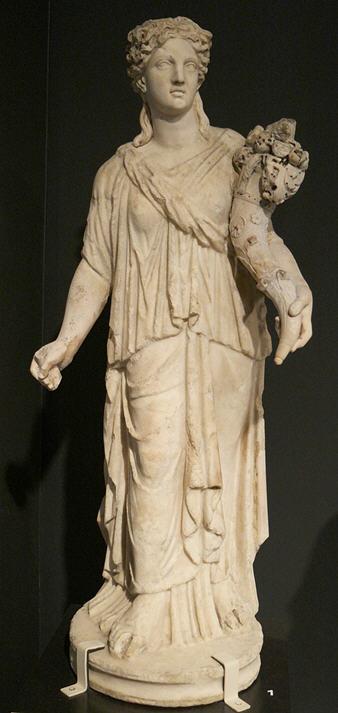
(Fæ, CC BY-SA 4.0, via Wikimedia Commons).
Also, from a contemporary Christian perspective, it is helpful to recall the Biblical quote from the Sermon on the Mount, namely:
So that you may be sons of your Father who is in heaven; for he makes his sun rise on the evil and on the good, and sends rain on the just and on the unjust.
Holy Bible (Revised Standard Version)
Matthew 5.45
This quotation implies that good and bad befall all of humanity, as seen through the eyes of one of the world’s great religions.
Looking to luck
Let us go through the standard procedure when playing Lotto in the next available draw, using a play slip in-store.
- Decide on how many boards you wish to play. Can you afford to play?
- Choose six numbers for each board.
- Mark the play slip clearly and unambiguously, preferably in black ink, for the best contrast.
- Give the play slip to the retailer with your stake.
- The retailer accepts your payment, inserts your play slip into the reader on his machine and then returns your play slip with a printed ticket.
Unless the machine rejects your play slip, you will have made a successful official entry at this stage. Camelot will record the details safely and securely in their computer system. - You await the draw and check the ticket against the results declared officially.
- Have you been lucky?
Either you have won a prize by matching sufficient or all of the numbers, or you have not.
If you have won nothing, your ticket is now spent and worthless, which is the fate of most of them. Your current Lotto journey has ended without reward. You are in the company of many!
For a small minority, things are different.
How you receive payment depends upon the amount you have won. You should return to a retailer who will validate your ticket and make payment for small cash prizes.
But, for more considerable sums, contact the National Lottery to check the eligibility. To learn how the National Lottery will settle payment with you, refer to its website for details.
Example of play
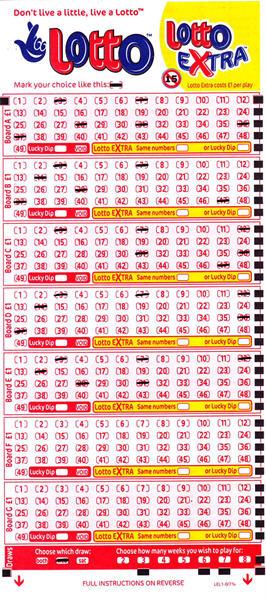
I played five boards of Lotto on Wednesday, 28 September 2005. Here is a copy of my play slip, my stake of £5 and the ticket that the retailer gave me.

Photograph of a rolled-up £5 note by Philip Veater on Unsplash

In draw 1019, held that evening, the winning balls were 21, 32, 41, 42, 43 and 46, with 17 as the bonus ball. I did not match a single ball and lost £5.
It was as well that my losses were so low. Losing £5 is undesirable but not too serious under normal circumstances. Some people playing slot machines in a casino can lose much more money quickly.

Losing large amounts of money is something you would wish to avoid repeating too often. However, a loss is inherent while gambling.
Regulation
The National Lottery regulator has put substantial obstacles in the way of prospective problem gamblers to mitigate against misuse and unbridled play. For example,
- Limiting the number of Lotto draws to two per week;
- Imposing cash limits on the amount spent weekly using the internet. The maximum you can add to your National Lottery account is £350 weekly.
- With seven boards per play slip, submitting many play slips to the reader in-store to pay for a large bet is time-consuming and attracts attention, to say nothing of the time taken to complete them accurately. The action is enough to deter all but the most determined of players.
Of course, there are impediments to excessive and reckless play in other settings, but they are not our concern.
Suffice it to say that Lotto does not lend itself so readily to gambling to excess as other forms. You can live the dream without it becoming a nightmare.
Facing failure head-on
Repeated failure begs the question: What can I do to succeed?
I could give luck a nudge.
Now might be the time to seek some advice!
Surfing the internet for advice
The World Wide Web has made research much more straightforward, although sometimes not always for the best. As a springboard, it makes an excellent tool with which to begin, but we should take care not to become complacent and accept only superficial answers to the questions we ask. We should be more discerning.
A quick trawl of the internet using a search engine like Google with terms like “how to win the lottery?” will throw up many results – some of a very doubtful value, especially if you add the word “guaranteed”.
Some results contain advice and comments from journalists and writers interested in lotteries especially. Some advice is tongue-in-cheek, but in many cases, the authors try to throw some light on certain aspects, such as the typical behaviour of players, and events that seem bizarre, to attract readers’ attention.
Early advice for players
I have prepared a list of 26 pieces of advice that I have taken from several websites and books. There is no significance in the order, nor have I verified any of the advice given. I have included the counsel because it attracted my attention, whether serious or frivolous.
- Never spend more money than you can afford to lose.
- Buy Lucky Dips.
- Choose numbers yourself; do not buy Lucky Dips.
- Try to take part in every draw even if you only buy one board.
- You should keep your ticket in a safe place that is known to you; do not lose it.
- Check your ticket against the published results carefully.
- If you have won a prize, claim before the deadline has expired. You have 180 days after the draw has taken place to file your claim before you forfeit your prize.
- Open an account with the National Lottery and buy your tickets online. If you do this, Camelot will check your tickets and will notify you automatically if you have won a prize.
- Adopt a system of your own and stick to it.
- Buy more boards than usual when there is a rollover.
- Play only when there is a rollover.
- Join a syndicate to spread the financial burden.
- Do not join a syndicate since you will have to share the winnings[1].
- Never base your selection entirely on birthdays, since prizes are likely to be extremely low.
- Avoid picking a board that contains small prime numbers[2], especially 7.
- Avoid multiples of small numbers[3].
- Do not make patterns on the play slip or construct arithmetic patterns[4] when choosing your numbers.
- Pick a board with 2 or 3 consecutive numbers. e.g. 11, 15, 24, 39, 40, 48.
- Do not squash the numbers on each board too closely – the difference[5] between the largest and smallest should be 25, at least.
- Ensure that the numbers comprising each board add up[6] to more than 177.
- It is better to buy 20 boards in one draw than one board on 20 separate occasions.
- Trust in cosmic forces. e.g. Look into a crystal ball, interpret dreams, or use clairvoyance.
- Move to Dumfries in Scotland, which has one lottery millionaire for every 8,288 adults.
- Include 38 in your selection but avoid 13. The number 38 has been drawn more often than any other so far, and 13 less frequently than all others.
- Take no notice of the results of previous draws. The balls are inanimate objects with no sense of their history. They do not have form like racehorses. Every combination of 6 numbers has an equal chance of being drawn[7], and there are 13,983,816 of them.
- Use a Perm
Players who play several boards per Lotto draw regularly use a perm[8]. To play, you pick more than six numbers and then construct Lotto boards using six of them at a time. The cost of covering all the combinations possible rises quickly with the overall number chosen[9]. Reduced perms are cheaper, but coverage is compromised. Avoiding some combinations may mean missing out on some prizes.
Finally, there is what might be loosely termed a gambler’s prayer. It stems from a catchphrase used often by Bob Monkhouse during his tenure as host of The National Lottery Live show broadcast on Saturday evenings on BBC1 and BBC One between 1996 and 1998.
I know I’m a sinner, but make me a winner!
Bob Monkhouse on The National Lottery Live show
This funny catchphrase carries a faint echo of a supposed longstanding link between the divine and humankind.
Weighing up the advice
Not every bit of advice carries the same weight. As you can see, some are plain common sense, often lacking where gambling is concerned, while others seem trivial or even absurd.
Some suggestions are based upon the statistical analyses of many draws in different lotteries, here and abroad. There have been attempts to find a relationship between the value of prizes and the numbers drawn. Here, the proposition is that a player can use the findings to pick numbers that are unlikely to result in sharing the more lucrative prizes.
Decide for yourself on the value of the advice above. Some are commendable, while others are not.
How players behave
Little is known about how UK players choose their boards in detail to produce meaningful patterns in behaviour. Camelot publishes the value of the prizes and the number of winners in each tier after every draw. Also, you could calculate the success rate for winners while Camelot released ticket sales. However, after nine years, Camelot ceased to publish the amounts in 2003.
Nevertheless, it is possible to estimate sales reliably and accurately. The success rate is 1.86%, averaging over 2,000 draws. Unfortunately, from this data, it is impossible to work out what patterns have appealed to losers, who account for approximately 98% of the boards played.
The Swiss lottery gave Hans Riedwyl privileged access to the combinations chosen by Swiss players for one week. He discovered the following preferences adopted by players:
- There was a tendency to replay combinations that had won historically in the Swiss and nearby foreign lotteries.
- Combinations that produced straight lines and zigzags on the play slip figured highly, along with other symmetrical geometrical patterns.
- There were other popular numerical patterns. e.g. Adding one to each number in lines that had won previously or subtracting one.
Recommendations
Hans Riedwyl[10] recommended the following actions based on his research to make winning higher prizes more likely. He suggested that a player make random choices and accepts them only if:
- The numbers add up to at least 177.
- Three, four or five of them lie along the edge of a board on the play slip.
- The six numbers are not isolated, nor do they form a single cluster.
- Reject all others.
This advice leaves about 1.5 million out of nearly 14 million combinations (49C6) from which to choose to pursue higher prizes, but it makes no difference to the chances of winning.
In the absence of evidence to the contrary, it is safe to assume that British players adopt similar methods to their Swiss counterparts and employ these methods steadily over time.
The first 70 draws
The infographic below shows how winning numbers would have appeared on play slips. The main balls appear red, while the bonus numbers are cyan.

First seventy draws – no Lucky Dips.
Look at draw 9, which produced a record number of 133 jackpot winners.
There were suspicions at first that a syndicate had managed to develop a winning system to “crack the lottery”, but they proved unfounded. A more likely explanation lay in the regularity of the pattern on the play slip and people’s haste or laziness in completion.
Lucky Dips were unavailable, so all play slips were completed manually.
Did I adhere to the recommendations?
Now, let us examine how closely I stuck to the recommendations made by Hans Riedwyl when I played the five boards that I described earlier.
- All of the totals came far from the target of 177.
- Using nine balls to form five boards, I aligned enough marks around the board’s edges.
- Only one ball appeared isolated per board.
- No apparent patterns emerged.
The tables summarise what I did.
| Board | #1 | #2 | #3 | #4 | #5 | #6 | Total |
|---|---|---|---|---|---|---|---|
| A | 3 | 7 | 28 | 31 | 36 | 37 | 142 |
| B | 3 | 7 | 14 | 28 | 37 | 47 | 136 |
| C | 3 | 7 | 12 | 31 | 36 | 47 | 136 |
| D | 3 | 7 | 12 | 14 | 36 | 37 | 109 |
| E | 3 | 7 | 12 | 14 | 28 | 31 | 95 |
| Ball | 3 | 7 | 12 | 14 | 28 | 31 | 36 | 37 | 47 |
|---|---|---|---|---|---|---|---|---|---|
| Occurs | 5 | 5 | 3 | 3 | 3 | 3 | 3 | 3 | 2 |
| Board | A | B | C | D | E |
|---|---|---|---|---|---|
| Marks along the edge of a board | 4 | 4 | 5 | 5 | 3 |
| Isolated balls on each board | 36 | 47 | 3 | 7 | 12 |
I did not win any prize, but Hans Riedwyl never claimed that I would. Caveat emptor!
Long term performance
Sometimes combinations of balls that fail in most draws succeed, making a worthless ticket valuable at the right time.
Suppose I had entered the same five Lotto lines in all draws using 49 balls between 19 November 1994 and 7 October 2015. i.e. 2,065 draws. How would I have fared?
Expenditure
There is a slight complication in that Camelot doubled the price of a board during the period. We need to account for this change – see below.
| 1,855 draws | 5 boards @ £1 per board, costing | £9,275 |
| 210 draws | 5 boards @ £2 per board, costing | £2,100 |
| 2,065 draws | Total cost: | £11,375 |
Winnings
| ID | Match 3 | Match 4 | Match 5 | Match 5+ | Match 6 | Frequency | Prize |
|---|---|---|---|---|---|---|---|
| 1 | 0 | 0 | 0 | 0 | 0 | 1,955 | None |
| 2 | 3 | 0 | 0 | 0 | 0 | 6 | £30 (or £75) |
| 3 | 2 | 0 | 0 | 0 | 0 | 30 | £20 (or £50) |
| 4 | 1 | 0 | 0 | 0 | 0 | 69 | £10 (or £25) |
| 5 | 2 | 2 | 0 | 0 | 0 | 1 | £76 |
| 6 | 4 | 1 | 0 | 0 | 0 | 1 | £76 |
| 7 | 3 | 1 | 0 | 0 | 0 | 1 | £89 |
| 9 | 4 | 0 | 0 | 0 | 0 | 1 | £40 |
| 11 | 0 | 1 | 0 | 0 | 0 | 1 | £43 |
| Totals | 2,065[11] | £2,049 |
Nine of 38 outcomes possible with this ticket appeared, and only 8 won a prize.
In this scenario, the probability of winning a prize in any tier is 0.0561 (or 5.61%, expressed as a percentage). i.e. (100% – 94.39%) = 5.61%.
Buying five boards instead of one multiplied the probability of winning by approximately three times, rather than producing the five-fold increase (5 × 1.86% = 9.3%) we might have expected intuitively. This observation implies that the probability of winning a prize is not directly proportional to the number of boards bought but that some other subtle relationship applies[12].
Summary
The table below summarises what I would have achieved over a period of nearly 21 years.
| Maximum winnings: | £89 |
| Total winnings: | £2,049 |
| Loss: £11,375 – £2,049 | £9,326 |
| Average prize over 110 successes: | £18.63 |
| Average winnings over 2,065 draws: | £0.99 |
So much for prosperity with that plan of playing five boards! I would have made a significant loss.
Indeed, I may not have felt the full impact over 21 years, unlike someone playing with more immediacy in a casino. However, a loss is undoubtedly a loss regardless of its time frame.
Probability of success
The bar chart below shows the likelihood of success in 2,065 draws by persevering with my five boards. With a probability of 3.81% at its peak, the most likely result would be 115 successes; I had 110 – see above.
The width at half-maximum is a common way of measuring overall success. By this measure, between 104 and 128 wins account for more than 75% of those observed in practice.

The truth is that I would have been more successful if I had chosen five boards at random – see the table below.
| (1) | 14 | 21 | 28 | 30 | 37 | 44 |
| (2) | 10 | 11 | 20 | 25 | 30 | 37 |
| (3) | 5 | 10 | 22 | 23 | 40 | 41 |
| (4) | 2 | 3 | 8 | 22 | 37 | 43 |
| (5) | 10 | 14 | 16 | 18 | 36 | 46 |
They would have given me a probability of success of 8.99%, winning between 171 and 200 times at half-maximum and peaking at 185 times (rather than 115). I would have collected £2,385 in prize money by spending the same amount on Lotto tickets, making me a net loss of (£11,375 – £2,385). i.e. £8,990.
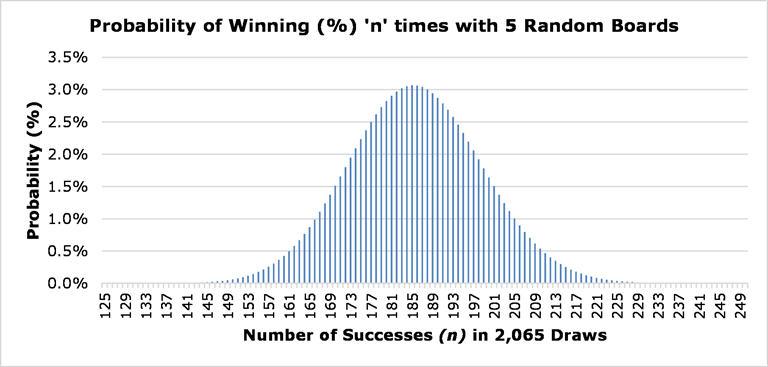
This finding encourages me since it implies that it is possible to achieve better results from the same expenditure of £5 per draw by tweaking the boards somehow. You can be sure we shall follow this line of inquiry later since it looks promising.
Suffice it to say that our choice of five boards affects the outcome significantly – for better or worse.
What if?
It is pertinent to consider here what might have happened had I deposited the money I would have spent on the lottery weekly in a building society savings account[13]. I have calculated the total amount I would have accrued by 14 October 2015 using several specimen interest rates.
| Savings Interest Rate | Amount saved |
| 1% | £11,396.40 |
| 2% | £11,417.85 |
| 3% | £11,439.35 |
| 4% | £11,460.91 |
| 5% | £11,482.52 |
This alternative shows what a mountain we must climb to make reliable gains by playing the lottery. The result pours cold water on our dreams. They may not be realistic and might be beyond our grasp.
Interest rates on savings plummeted sharply over the period due to the impact of the worldwide financial crisis that began in 2008. The bar chart[14] below illustrates the change.

Notes
- [1] According to Camelot, syndicates win approximately 1 in 7 jackpots over £1 million.
- [2] A prime number is a number, greater than 1, that is divisible only by itself or 1 without a remainder. The prime numbers available on an original Lotto board are: 2, 3, 5, 7, 11, 13, 17, 19, 23, 29, 31, 37, 41, 43 and 47. The small prime numbers appear in bold print.
- [3] e.g. 3, 9, 12, 36, 45, 48 – contains multiples of 3.
5, 10, 15, 20, 25, 30 – contains multiples of 5. - [4] e.g. 1, 8, 15, 22, 29, 36 – here, seven separates each number in the sequence (an arithmetic progression).
1, 4, 9, 16, 25, 36 – the numbers are squares of 1 to 6.
1, 2, 4, 8, 16, 32 (a geometrical progression with a common ratio of 2). - [5] In the example quoted in item 18, the difference is (48 – 11) = 37.
- [6] In the example quoted in item 18, the sum is: 11 + 15 + 24 + 39 + 40 + 48 = 177.
- [7] Even 1, 2, 3, 4, 5, 6! Believe it or not, Camelot has reported that about 10,000 players use this combination in every draw. The jackpot would be ridiculously small if these numbers were to appear. Even with a guaranteed jackpot of £10 million, jackpot winners would be lucky to receive £1,000 each.
- [8] The term perm (short for permutations) is a misnomer since it would imply that the order in which the items are chosen is significant. For Lotto, the order in which the balls appear is irrelevant. Operators of the Football Pools in the UK used to promote perms to help punters. e.g. through Littlewoods Lit-Plans and Perms. To date, Camelot has made no provision whatsoever for perms. It is easy to see why. A line in a Lit-Plan was a penny or fraction thereof but, each Lotto board cost £1 initially, making even the simplest perm expensive and at odds with the policy of discouraging gambling to excess.
- [9] For example, there are 28 ways of combining eight balls six at a time, and 84 ways of combining nine balls six at a time. You would need to play 28 and 84 boards respectively to cover these combinations.
- [10] “How to Win More: Strategies for Increasing a Lottery Win” (1998) by N. Henze and H. Riedwyl.
- [11] I would have won prizes in 110 of the 2,065 draws, and nothing in the remaining 1,955. My success rate would have been 5.3%.
- [12] Here, I have to make an admission! The five boards I chose were not random but were related to each other. In trying to make improvements, I made matters worse. Had I chosen five Lucky Dips, I would have fared better with a winning probability of 9.00% ± 0.13%, close to the 9.3% expected.
- [13] This brings to mind an account I read of Margaret Thatcher reproaching a woman she encountered buying a National Lottery ticket in a newsagent, urging her not to waste her precious coin. “Don’t waste it, dear, you should invest that pound instead. Invest it in the future of British manufacturing and industry. Watch your savings grow, dear.” However, this could be an urban myth.
- [14] I obtained a list of savings interest rates from Swanlow Park.
Revision date: 5 March 2023