How the Liverpool Hope method works
In 1999, three mathematicians from Liverpool Hope University devised a system for winning the National Lottery online game.
Their ingenious solution used 290 combinations of the 13,983,816 possible. It guarantees that players will win at least two Match 3 prizes, no matter which six main balls are drawn from 49.
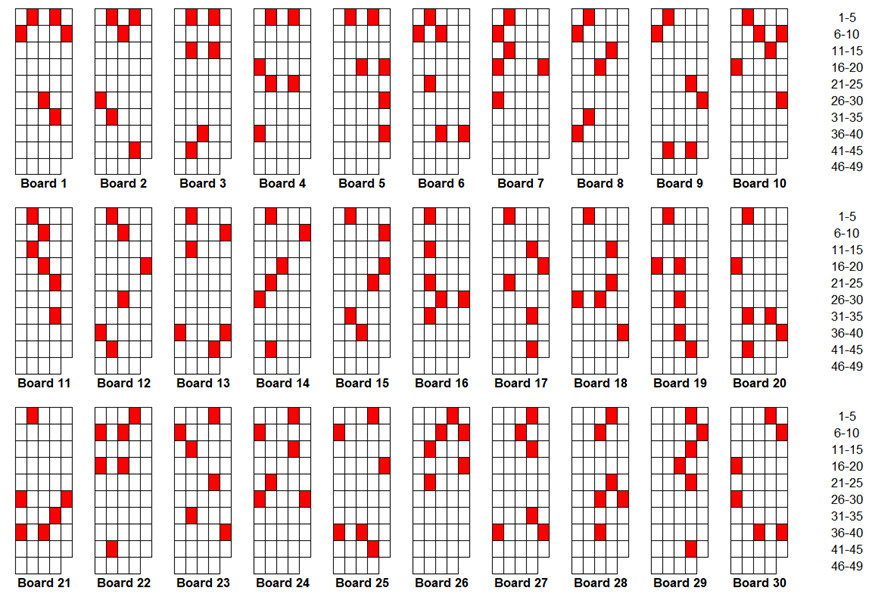
However, making a profit is unlikely. In the first 332 draws, they reported a 28% return on their expenditure—a considerable net loss. Sadly, it was not possible to beat the National Lottery.
The cost was significant, making it a viable option only for syndicates. On reflection, deriving a minimum return of £20 for a stake of £290 is not a bargain for most people.
The online game was renamed Lotto in 2002. The authors’ system is obsolete now. From draw 2066 onwards, Lotto continues to be played with 59 balls instead of 49.
Their method is worth studying, nevertheless, since it provides insights. How does it work? Let’s investigate.
This article explains their method step by step.
Table of contents
Estimated reading time: 20 minutes
Interesting research
The Daily Telegraph article described how three mathematicians from Liverpool Hope University had devised a winning system derived from a branch of mathematics called group theory. Subsequently, the group (comprising Dr John Brinkman, Dr David Hodgkinson and Dr John Humphreys) published a paper in The Mathematical Gazette, Vol. 85, No. 503 (Jul 2001), pp 202-207.

Reproduced with permission from The Telegraph
They applied their method to a National Lottery game[1] played with 49 balls. The unit of play was a board of six numbers, which cost £1.
How did you win a prize then?
To recap, before the draw, a player would choose six unique numbers between 1 and 49 inclusively to form a line called a board, hoping their selection would match all the main numbers drawn to win the jackpot.
During each televised draw, the balls were jumbled in a drum to mix them thoroughly, and then a mechanism released seven balls down a chute for all to see. The first six were the main balls; the seventh was the bonus.
Prize Structure
The online National Lottery game, now called Lotto, had five prize categories, typically ranging from a fixed £10 minimum to about £1,000,000. Except for the minimum, the value of each price depended on the money raised from the sale of lottery tickets and the number of winners in each category. Strict rules governed the game.
Here is an example.
| Prize Tier | Winners | Prize |
|---|---|---|
| Match 3 | 1,126,075 | £10 |
| Match 4 | 60,622 | £67 |
| Match 5 | 1,120 | £1,654 |
| Match 5+ | 29 | £102,262 |
| Match 6 | 10 | £963,820 |
| Total: | 1,187,856 | £29,778,702 |
| Balls: 5, 10, 19, 24, 34, 46, bonus 28 | ||
| Sales: £66,212,779 | Success rate: 1.79% | |
| Taken together, Match 3 and Match 4 winners accounted for 99.9% of the total. | ||

Number Patterns
Whereas jackpot winners must match all six main numbers, a minimum prize of £10 could be obtained by matching just three of the main numbers drawn by Camelot.
This observation suggests that winning the jackpot might be possible by combining two minimum prizes judiciously. But the question is how?
One-third of all possible combinations (i.e. 4,655,200) contain three odd and three even numbers — an odd triplet and an even triplet[2], which form the basis of the minimum prize guarantee.
Triplets
There are 49C3 triplets with 49 balls.
$$ \begin{split}^{49}C_3& = \frac{49!}{3! × 46!}\\ \\&=\frac{(49×48×47×46×45×44×43×\dotso×6×5×4×3×2×1)}{(3×2×1)×(46×45×44×\dotso×3×2×1)}\\ \\&=18424 \end{split} $$Not all of them are odd or even; some are mixed. The following table shows their breakdown.
| Type | Quantity | Examples |
|---|---|---|
| Odd | 2,300 | {1, 3, 5}, {11, 13, 15}, {45, 47, 49} |
| Even | 2,024 | {2, 4, 6}, {10, 36, 48}, {44, 46, 48} |
| Mixed | 14,100 | {1, 2, 3}, {10, 37, 41}, {47, 48, 49} |
| Total: | 18,424 | To obtain a solution, we would need to consider a maximum of 4,324 triplets (23.5% of the total). |
Accordingly, we can consider a maximum of 4,324 triplets (23.5% of the total) to obtain a solution.
Of the 49 balls, 25 are odd numbers, and 24 are even.
{1, 3, 5, 7, 9, 11, 13, 15, 17, 19, 21, 23, 25, 27, 29, 31, 33, 35, 37, 39, 41, 43, 45, 47, 49} and
{2, 4, 6, 8, 10, 12, 14, 16, 18, 20, 22, 24, 26, 28, 30, 32, 34, 36, 38, 40, 42, 44, 46, 48}.
It should be possible to cover all possibilities in the table optimally below by building two lists of sextets (i.e. boards)
- from triplets containing odd numbers only,
- from triplets comprising even numbers only.
I have shaded the table to give visual impact and show how their scheme works.
| Composition | No. of Combinations | % | Example | |||||
|---|---|---|---|---|---|---|---|---|
| 6 odd numbers | 177,100 | 1.3 | 1 | 11 | 23 | 29 | 33 | 37 |
| 5 odd and 1 even | 1,275,120 | 9.1 | 3 | 9 | 18 | 21 | 31 | 45 |
| 4 odd and 2 even | 3,491,400 | 25.0 | 3 | 5 | 11 | 32 | 46 | 49 |
| 3 odd and 3 even | 4,655,200 | 33.3 | 1 | 8 | 16 | 23 | 25 | 36 |
| 2 odd and 4 even | 3,187,800 | 22.8 | 3 | 14 | 17 | 20 | 38 | 44 |
| 1 odd and 5 even | 1,062,600 | 7.6 | 1 | 12 | 20 | 26 | 42 | 48 |
| 6 even numbers | 134,596 | 1.0 | 2 | 10 | 16 | 28 | 34 | 40 |
| Total | 13,983,816 | 100.0 | ||||||
Notes on the shaded table
- The collection of odd-numbered boards caters for the outcomes shaded in pastel green.
- The collection of even-numbered boards caters for these outcomes, shaded in pastel lilac.
- Using separate collections for odd-numbered and even-numbered boards covers cases where the jackpot winning combination contains three odd and three even numbers, shaded in yellow.
This approach shows promise.
The Liverpool Hope method
The researchers posed the following question.
How many boards n should a syndicate buy to guarantee winning at least one prize? i.e. what is the value of n?
They devised their solution using discoveries in combinatorics, an area of mathematics. They did not expect to “beat” the National Lottery; that would be very unlikely!
Their approach was to buy enough boards to include every odd and even triplet.
Summary of their solution
To participate, you had to complete 290 boards. In return, their system guaranteed that you would win two Match 3 prizes as a minimum; usually, the result would be much more rewarding with Match 4 or 5 prizes.
Getting a minimum return of £20 for a stake of £290 might not seem like a bargain to most people. Undoubtedly, the cost would be prohibitive for most solo players. But, it might work for a syndicate, where the financial burden is shared.
Much depends upon how well their system might behave in the medium to long term. It would help if you had patience and perseverance to reap a decent reward, assuming that one ever materialised.
Had they played this way from the beginning until 27 February 1999 (i.e. 332 draws), the trio would have received a return of 28%.
What interested me the most was how the system operated. Finally, a method with some meat emerged that did not rely on forecasting.
There will always be a financial reward, but it might not cover the stake and make a profit.
The number of odd triplets must be reduced to a minimum to generate an affordable solution, then similarly, for even triplets.
Steiner systems
The Liverpool Hope researchers decided to tackle the problem using a combinatorial system devised by a Swiss mathematician, Jakob Steiner (1796-1863).
What follows is an introductory discussion of a complicated subject[3]; it should meet the immediate need and still whet your appetite.
Consider a set X with n elements.
A Steiner system S(t, k, n) of n elements has k subsets called blocks, which have the property that each t–element subset of X, called a party, is a subset of only one block.
In the original formulation[4], the parties were pairs (t = 2), and the blocks were triples/triplets (k = 3), represented as S(2, 3, n).
It follows that n > k > t > 1 for non-trivial results. i.e. the set X must have
- more members n than there are blocks, k
- more blocks k than there are parties, t
- and more parties t than one.
Let’s clarify the situation using a simple example.
e.g. Suppose that a set X has seven elements, where X = { 1, 2, 3, 4, 5, 6, 7 }.
I have set up the 7C3 triplets and 7C2 pairs and found that the Steiner system S(2, 3, 7) consists of 7 Steiner triplets, in which each element of X appears three times – see the panel below.

Examples of Steiner systems
Few Steiner systems are known, but there are some noteworthy examples which I shall mention briefly.
Kirkman’s schoolgirl problem – S(2, 3, 15)
The Reverend Thomas Kirkman FRS (1806-1895), an English clergyman and mathematics graduate of Trinity College, Dublin, solved the following problem in 1846. It is known as Kirkman’s schoolgirl problem.
Fifteen young ladies in a school walk out three abreast for seven days in succession: it is required to arrange them daily, so that no two shall walk twice abreast.
Its solution predated Steiner’s work, published in 1853.
Mathieu Groups
After French mathematician Émile Léonard Mathieu (1835-1890), finite simple groups called Mathieu groups arose from Steiner systems.
- Mathieu M11 – S(4, 5, 11)
- Mathieu M12 – S(5, 6, 12)
- Mathieu M22 – S(3, 6, 22)
- Mathieu M23 – S(4, 7, 23)
- Mathieu M24 – S(5, 8, 24)
Golay Error Correcting code G24 – S(5, 8, 24)
In coding theory, Marcel J E Golay (1902-1989) discovered the Golay error codes G23 and G24, which underpin digital communications. G24 encodes 12 bits in a 24-bit word, enabling 3-bit errors to be corrected and 4-bit errors to be detected.
Miracle Octad Generator
A mathematical tool called the Miracle Octad Generator developed by R T Curtis[5] can produce blocks of 8 elements, octads.
Properties of Steiner systems
If S(t, k, n) is a Steiner system,
S(t-1, k-1, n-1) is a Steiner system, too.
Removing one element from the base set produces another Steiner system.
The number of blocks b produced by the quotient of nCt and kCt must be an integer if S(t, k, n) is a Steiner system.
$$ \begin{align*}Blocks, b& = \frac{\binom{n}{t}}{\binom{k}{t}} ≡ \frac{^{n}C_t}{^{k}C_t}\\ \end{align*} $$
Combining the two properties above produces an admissibility condition for the existence of a Steiner system.
$$ \begin{align*}\text{Admissibility : }\ \ ^{n-i}C_{t-i}\text{ is exactly divisible by }^{k-i}C_{t-i}\text{ for }i = 0, 1, \dots, t-1\text{ if } S(t, k, n)\text{ is a Steiner system.}\end{align*} $$
Use the formula below to calculate each element’s frequency of recurrence r across all blocks.
$$ \begin{align*}Recurrence, r & = \frac{\binom{n-1}{t-1}}{\binom{k-1}{t-1}} ≡ \frac{^{n-1}C_{t-1}}{^{k-1}C_{t-1}}\\ \end{align*} $$
| System | t | k | n | nCt | kCt | Blocks, b nCt ÷ kCt | Recurrence, r n-1Ct-1 ÷ k-1Ct-1 |
|---|---|---|---|---|---|---|---|
| S(5, 8, 24) | 5 | 8 | 24 | 42,504 | 56 | 759 | 253 |
| S(4, 7, 23) | 4 | 7 | 23 | 8,855 | 35 | 253 | 77 |
| S(3, 6, 22) | 3 | 6 | 22 | 1,540 | 20 | 77 | 21 |
| S(2, 5, 21) | 2 | 5 | 21 | 210 | 10 | 21 | 5 |
| S(1, 4, 20) | 1 | 4 | 20 | 20 | 4 | 5 | 1 |
However, disappointedly, S(3, 6, 49), which would model our lottery problem, is NOT a Steiner system since the quotient is not an integer – a necessary condition.
$$ \begin{align*}\frac{^{49}C_3}{^{6}C_3}=\frac{18424}{20}=921.2 \; boards \end{align*} $$Fortunately, this discovery did not thwart the enterprise, since the three mathematicians found a way around this apparent setback.
Steps in the solution
Preamble
The researchers noted that:
- the Steiner system S(5, 8, 24) was well developed and understood and that
- 24 of the 49 balls used in Lotto then were even — i.e. 2, 4, 6, …, 46, 48.
Unfortunately, no Steiner system S(3, 6, 24) exists since neither of the two quotients below are whole numbers.
$$ \begin{align*}Blocks, b& = \frac{^{24}C_3}{^{6}C_3} = \frac{2024}{20} = 101.2\\ \end{align*} $$ $$ \begin{align*}Recurrence, r & = \frac{^{23}C_{2}}{^{5}C_{2}} = \frac{253}{10} = 25.3\\ \end{align*} $$However, the Miracle Octad Generator could produce the 753 blocks in Steiner system S(5, 8, 24).
Removing 48 and then 46 from the starting set of 24 even numbers (i.e. {2, 4, …, 46, 48}) produces the Steiner system S(4, 7, 23) and ultimately S(3, 6, 22) after adjusting the blocks and parties accordingly.
The table below shows the outcome – 77 blocks comprising the Steiner system S(3, 6, 22), in which each even number occurs 21 times.
| ID | 2 | 4 | 6 | 8 | 10 | 12 | 14 | 16 | 18 | 20 | 22 | 24 | 26 | 28 | 30 | 32 | 34 | 36 | 38 | 40 | 42 | 44 | 46 | 48 |
|---|---|---|---|---|---|---|---|---|---|---|---|---|---|---|---|---|---|---|---|---|---|---|---|---|
| 1 | 2 | 4 | 6 | 10 | 28 | 34 | ||||||||||||||||||
| 2 | 2 | 4 | 8 | 26 | 32 | 44 | ||||||||||||||||||
| 3 | 2 | 4 | 12 | 14 | 38 | 42 | ||||||||||||||||||
| 4 | 2 | 4 | 16 | 22 | 24 | 36 | ||||||||||||||||||
| 5 | 2 | 4 | 18 | 20 | 30 | 40 | ||||||||||||||||||
| 6 | 2 | 6 | 8 | 22 | 38 | 40 | ||||||||||||||||||
| 7 | 2 | 6 | 12 | 16 | 20 | 26 | ||||||||||||||||||
| 8 | 2 | 6 | 14 | 18 | 32 | 36 | ||||||||||||||||||
| 9 | 2 | 6 | 24 | 30 | 42 | 44 | ||||||||||||||||||
| 10 | 2 | 8 | 10 | 14 | 16 | 30 | ||||||||||||||||||
| 11 | 2 | 8 | 12 | 18 | 24 | 34 | ||||||||||||||||||
| 12 | 2 | 8 | 20 | 28 | 36 | 42 | ||||||||||||||||||
| 13 | 2 | 10 | 12 | 36 | 40 | 44 | ||||||||||||||||||
| 14 | 2 | 10 | 18 | 22 | 26 | 42 | ||||||||||||||||||
| 15 | 2 | 10 | 20 | 24 | 32 | 38 | ||||||||||||||||||
| 16 | 2 | 12 | 22 | 28 | 30 | 32 | ||||||||||||||||||
| 17 | 2 | 14 | 20 | 22 | 34 | 44 | ||||||||||||||||||
| 18 | 2 | 14 | 24 | 26 | 28 | 40 | ||||||||||||||||||
| 19 | 2 | 16 | 18 | 28 | 38 | 44 | ||||||||||||||||||
| 20 | 2 | 16 | 32 | 34 | 40 | 42 | ||||||||||||||||||
| 21 | 2 | 26 | 30 | 34 | 36 | 38 | ||||||||||||||||||
| 22 | 4 | 6 | 8 | 16 | 18 | 42 | ||||||||||||||||||
| 23 | 4 | 6 | 12 | 24 | 32 | 40 | ||||||||||||||||||
| 24 | 4 | 6 | 14 | 22 | 26 | 30 | ||||||||||||||||||
| 25 | 4 | 6 | 20 | 36 | 38 | 44 | ||||||||||||||||||
| 26 | 4 | 8 | 10 | 12 | 20 | 22 | ||||||||||||||||||
| 27 | 4 | 8 | 14 | 34 | 36 | 40 | ||||||||||||||||||
| 28 | 4 | 8 | 24 | 28 | 30 | 38 | ||||||||||||||||||
| 29 | 4 | 10 | 14 | 18 | 24 | 44 | ||||||||||||||||||
| 30 | 4 | 10 | 16 | 26 | 38 | 40 | ||||||||||||||||||
| 31 | 4 | 10 | 30 | 32 | 36 | 42 | ||||||||||||||||||
| 32 | 4 | 12 | 16 | 30 | 34 | 44 | ||||||||||||||||||
| 33 | 4 | 12 | 18 | 26 | 28 | 36 | ||||||||||||||||||
| 34 | 4 | 14 | 16 | 20 | 28 | 32 | ||||||||||||||||||
| 35 | 4 | 18 | 22 | 32 | 34 | 38 | ||||||||||||||||||
| 36 | 4 | 20 | 24 | 26 | 34 | 42 | ||||||||||||||||||
| 37 | 4 | 22 | 28 | 40 | 42 | 44 | ||||||||||||||||||
| 38 | 6 | 8 | 10 | 24 | 26 | 36 | ||||||||||||||||||
| 39 | 6 | 8 | 12 | 14 | 28 | 44 | ||||||||||||||||||
| 40 | 6 | 8 | 20 | 30 | 32 | 34 | ||||||||||||||||||
| 41 | 6 | 10 | 12 | 18 | 30 | 38 | ||||||||||||||||||
| 42 | 6 | 10 | 14 | 20 | 40 | 42 | ||||||||||||||||||
| 43 | 6 | 10 | 16 | 22 | 32 | 44 | ||||||||||||||||||
| 44 | 6 | 12 | 22 | 34 | 36 | 42 | ||||||||||||||||||
| 45 | 6 | 14 | 16 | 24 | 34 | 38 | ||||||||||||||||||
| 46 | 6 | 16 | 28 | 30 | 36 | 40 | ||||||||||||||||||
| 47 | 6 | 18 | 20 | 22 | 24 | 28 | ||||||||||||||||||
| 48 | 6 | 18 | 26 | 34 | 40 | 44 | ||||||||||||||||||
| 49 | 6 | 26 | 28 | 32 | 38 | 42 | ||||||||||||||||||
| 50 | 8 | 10 | 18 | 28 | 32 | 40 | ||||||||||||||||||
| 51 | 8 | 10 | 34 | 38 | 42 | 44 | ||||||||||||||||||
| 52 | 8 | 12 | 16 | 32 | 36 | 38 | ||||||||||||||||||
| 53 | 8 | 12 | 26 | 30 | 40 | 42 | ||||||||||||||||||
| 54 | 8 | 14 | 18 | 20 | 26 | 38 | ||||||||||||||||||
| 55 | 8 | 14 | 22 | 24 | 32 | 42 | ||||||||||||||||||
| 56 | 8 | 16 | 20 | 24 | 40 | 44 | ||||||||||||||||||
| 57 | 8 | 16 | 22 | 26 | 28 | 34 | ||||||||||||||||||
| 58 | 8 | 18 | 22 | 30 | 36 | 44 | ||||||||||||||||||
| 59 | 10 | 12 | 14 | 26 | 32 | 34 | ||||||||||||||||||
| 60 | 10 | 12 | 16 | 24 | 28 | 42 | ||||||||||||||||||
| 61 | 10 | 14 | 22 | 28 | 36 | 38 | ||||||||||||||||||
| 62 | 10 | 16 | 18 | 20 | 34 | 36 | ||||||||||||||||||
| 63 | 10 | 20 | 26 | 28 | 30 | 44 | ||||||||||||||||||
| 64 | 10 | 22 | 24 | 30 | 34 | 40 | ||||||||||||||||||
| 65 | 12 | 14 | 16 | 18 | 22 | 40 | ||||||||||||||||||
| 66 | 12 | 14 | 20 | 24 | 30 | 36 | ||||||||||||||||||
| 67 | 12 | 18 | 20 | 32 | 42 | 44 | ||||||||||||||||||
| 68 | 12 | 20 | 28 | 34 | 38 | 40 | ||||||||||||||||||
| 69 | 12 | 22 | 24 | 26 | 38 | 44 | ||||||||||||||||||
| 70 | 14 | 16 | 26 | 36 | 42 | 44 | ||||||||||||||||||
| 71 | 14 | 18 | 28 | 30 | 34 | 42 | ||||||||||||||||||
| 72 | 14 | 30 | 32 | 38 | 40 | 44 | ||||||||||||||||||
| 73 | 16 | 18 | 24 | 26 | 30 | 32 | ||||||||||||||||||
| 74 | 16 | 20 | 22 | 30 | 38 | 42 | ||||||||||||||||||
| 75 | 18 | 24 | 36 | 38 | 40 | 42 | ||||||||||||||||||
| 76 | 20 | 22 | 26 | 32 | 36 | 40 | ||||||||||||||||||
| 77 | 24 | 28 | 32 | 34 | 36 | 44 | ||||||||||||||||||
| Occurs | 21 | 21 | 21 | 21 | 21 | 21 | 21 | 21 | 21 | 21 | 21 | 21 | 21 | 21 | 21 | 21 | 21 | 21 | 21 | 21 | 21 | 21 | 0 | 0 |
- The table covers the first twenty-two even numbers between 2 and 44 but does not provide for numbers 46 and 48, which are often drawn.
- Therefore, the scheme needs improvement; more tickets are required to complete its coverage.
- To do this, first, identify the blocks that contain 44; the darker background identifies this 44-cohort.
Even numbers plus 46
Take the 44-cohort and add 2 to each element to produce 21 further rows – IDs 78-98. From this point, no Steiner system is involved.

The triplets covered have the form {x, y, 46}, where x < y, x > 2 and y < 46.
Even numbers plus 48
Again, take the 44-cohort and add 4 to each element, producing another 21 rows with IDs 99-119.
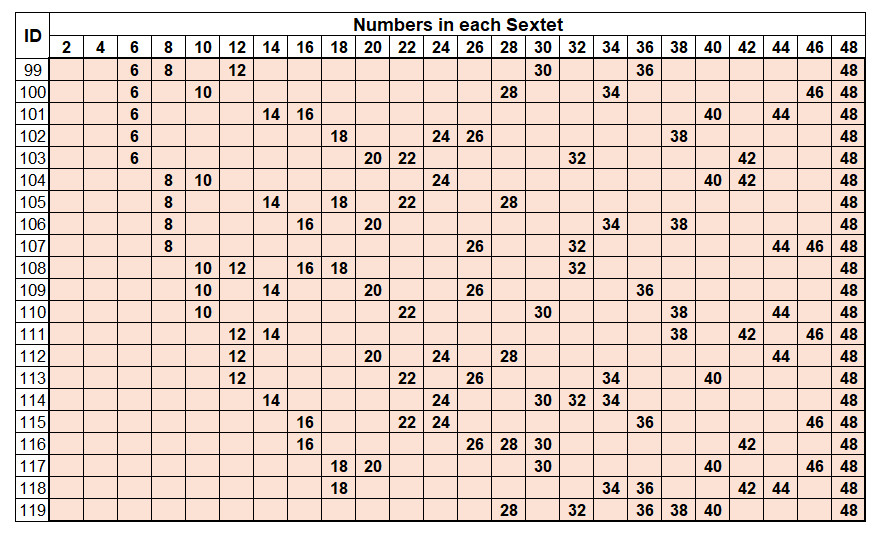
More triplets are covered, having the form {x, y, 48}, where x < y, x > 4 and y < 48.
Even numbers – special cases
All that is missing are triplets that look like:
- {2, x, 46}, where 2 < x < 46,
- {2, x, 48}, where 2 < x < 48, and
- {4, x, 48}, where 4 < x < 48.
Ten more boards will suffice with the form {2, 4, x, y, 46, 48}, where x and y are even numbers from 6 to 44, making 129 boards in all to cover boards consisting entirely of even numbers.

Odd numbers
Turning their attention to odd numbers, the researchers began by collecting the 129 rows of 6 even numbers. Then, they created the table below by subtracting one from each element, converting every even number into an odd one.
| ID | 1 | 3 | 5 | 7 | 9 | 11 | 13 | 15 | 17 | 19 | 21 | 23 | 25 | 27 | 29 | 31 | 33 | 35 | 37 | 39 | 41 | 43 | 45 | 47 | 49 |
|---|---|---|---|---|---|---|---|---|---|---|---|---|---|---|---|---|---|---|---|---|---|---|---|---|---|
| 1 | 1 | 3 | 5 | 9 | 27 | 33 | |||||||||||||||||||
| 2 | 1 | 3 | 7 | 25 | 31 | 43 | |||||||||||||||||||
| 3 | 1 | 3 | 11 | 13 | 37 | 41 | |||||||||||||||||||
| 4 | 1 | 3 | 15 | 21 | 23 | 35 | |||||||||||||||||||
| 5 | 1 | 3 | 17 | 19 | 29 | 39 | |||||||||||||||||||
| 6 | 1 | 5 | 7 | 21 | 37 | 39 | |||||||||||||||||||
| 7 | 1 | 5 | 11 | 15 | 19 | 25 | |||||||||||||||||||
| 8 | 1 | 5 | 13 | 17 | 31 | 35 | |||||||||||||||||||
| 9 | 1 | 5 | 23 | 29 | 41 | 43 | |||||||||||||||||||
| 10 | 1 | 7 | 9 | 13 | 15 | 29 | |||||||||||||||||||
| 11 | 1 | 7 | 11 | 17 | 23 | 33 | |||||||||||||||||||
| 12 | 1 | 7 | 19 | 27 | 35 | 41 | |||||||||||||||||||
| 13 | 1 | 9 | 11 | 35 | 39 | 43 | |||||||||||||||||||
| 14 | 1 | 9 | 17 | 21 | 25 | 41 | |||||||||||||||||||
| 15 | 1 | 9 | 19 | 23 | 31 | 37 | |||||||||||||||||||
| 16 | 1 | 11 | 21 | 27 | 29 | 31 | |||||||||||||||||||
| 17 | 1 | 13 | 19 | 21 | 33 | 43 | |||||||||||||||||||
| 18 | 1 | 13 | 23 | 25 | 27 | 39 | |||||||||||||||||||
| 19 | 1 | 15 | 17 | 27 | 37 | 43 | |||||||||||||||||||
| 20 | 1 | 15 | 31 | 33 | 39 | 41 | |||||||||||||||||||
| 21 | 1 | 25 | 29 | 33 | 35 | 37 | |||||||||||||||||||
| 22 | 3 | 5 | 7 | 15 | 17 | 41 | |||||||||||||||||||
| 23 | 3 | 5 | 11 | 23 | 31 | 39 | |||||||||||||||||||
| 24 | 3 | 5 | 13 | 21 | 25 | 29 | |||||||||||||||||||
| 25 | 3 | 5 | 19 | 35 | 37 | 43 | |||||||||||||||||||
| 26 | 3 | 7 | 9 | 11 | 19 | 21 | |||||||||||||||||||
| 27 | 3 | 7 | 13 | 33 | 35 | 39 | |||||||||||||||||||
| 28 | 3 | 7 | 23 | 27 | 29 | 37 | |||||||||||||||||||
| 29 | 3 | 9 | 13 | 17 | 23 | 43 | |||||||||||||||||||
| 30 | 3 | 9 | 15 | 25 | 37 | 39 | |||||||||||||||||||
| 31 | 3 | 9 | 29 | 31 | 35 | 41 | |||||||||||||||||||
| 32 | 3 | 11 | 15 | 29 | 33 | 43 | |||||||||||||||||||
| 33 | 3 | 11 | 17 | 25 | 27 | 35 | |||||||||||||||||||
| 34 | 3 | 13 | 15 | 19 | 27 | 31 | |||||||||||||||||||
| 35 | 3 | 17 | 21 | 31 | 33 | 37 | |||||||||||||||||||
| 36 | 3 | 19 | 23 | 25 | 33 | 41 | |||||||||||||||||||
| 37 | 3 | 21 | 27 | 39 | 41 | 43 | |||||||||||||||||||
| 38 | 5 | 7 | 9 | 23 | 25 | 35 | |||||||||||||||||||
| 39 | 5 | 7 | 11 | 13 | 27 | 43 | |||||||||||||||||||
| 40 | 5 | 7 | 19 | 29 | 31 | 33 | |||||||||||||||||||
| 41 | 5 | 9 | 11 | 17 | 29 | 37 | |||||||||||||||||||
| 42 | 5 | 9 | 13 | 19 | 39 | 41 | |||||||||||||||||||
| 43 | 5 | 9 | 15 | 21 | 31 | 43 | |||||||||||||||||||
| 44 | 5 | 11 | 21 | 33 | 35 | 41 | |||||||||||||||||||
| 45 | 5 | 13 | 15 | 23 | 33 | 37 | |||||||||||||||||||
| 46 | 5 | 15 | 27 | 29 | 35 | 39 | |||||||||||||||||||
| 47 | 5 | 17 | 19 | 21 | 23 | 27 | |||||||||||||||||||
| 48 | 5 | 17 | 25 | 33 | 39 | 43 | |||||||||||||||||||
| 49 | 5 | 25 | 27 | 31 | 37 | 41 | |||||||||||||||||||
| 50 | 7 | 9 | 17 | 27 | 31 | 39 | |||||||||||||||||||
| 51 | 7 | 9 | 33 | 37 | 41 | 43 | |||||||||||||||||||
| 52 | 7 | 11 | 15 | 31 | 35 | 37 | |||||||||||||||||||
| 53 | 7 | 11 | 25 | 29 | 39 | 41 | |||||||||||||||||||
| 54 | 7 | 13 | 17 | 19 | 25 | 37 | |||||||||||||||||||
| 55 | 7 | 13 | 21 | 23 | 31 | 41 | |||||||||||||||||||
| 56 | 7 | 15 | 19 | 23 | 39 | 43 | |||||||||||||||||||
| 57 | 7 | 15 | 21 | 25 | 27 | 33 | |||||||||||||||||||
| 58 | 7 | 17 | 21 | 29 | 35 | 43 | |||||||||||||||||||
| 59 | 9 | 11 | 13 | 25 | 31 | 33 | |||||||||||||||||||
| 60 | 9 | 11 | 15 | 23 | 27 | 41 | |||||||||||||||||||
| 61 | 9 | 13 | 21 | 27 | 35 | 37 | |||||||||||||||||||
| 62 | 9 | 15 | 17 | 19 | 33 | 35 | |||||||||||||||||||
| 63 | 9 | 19 | 25 | 27 | 29 | 43 | |||||||||||||||||||
| 64 | 9 | 21 | 23 | 29 | 33 | 39 | |||||||||||||||||||
| 65 | 11 | 13 | 15 | 17 | 21 | 39 | |||||||||||||||||||
| 66 | 11 | 13 | 19 | 23 | 29 | 35 | |||||||||||||||||||
| 67 | 11 | 17 | 19 | 31 | 41 | 43 | |||||||||||||||||||
| 68 | 11 | 19 | 27 | 33 | 37 | 39 | |||||||||||||||||||
| 69 | 11 | 21 | 23 | 25 | 37 | 43 | |||||||||||||||||||
| 70 | 13 | 15 | 25 | 35 | 41 | 43 | |||||||||||||||||||
| 71 | 13 | 17 | 27 | 29 | 33 | 41 | |||||||||||||||||||
| 72 | 13 | 29 | 31 | 37 | 39 | 43 | |||||||||||||||||||
| 73 | 15 | 17 | 23 | 25 | 29 | 31 | |||||||||||||||||||
| 74 | 15 | 19 | 21 | 29 | 37 | 41 | |||||||||||||||||||
| 75 | 17 | 23 | 35 | 37 | 39 | 41 | |||||||||||||||||||
| 76 | 19 | 21 | 25 | 31 | 35 | 39 | |||||||||||||||||||
| 77 | 23 | 27 | 31 | 33 | 35 | 43 | |||||||||||||||||||
| 78 | 3 | 5 | 9 | 27 | 33 | 45 | |||||||||||||||||||
| 79 | 3 | 7 | 25 | 31 | 43 | 45 | |||||||||||||||||||
| 80 | 3 | 11 | 13 | 37 | 41 | 45 | |||||||||||||||||||
| 81 | 3 | 15 | 21 | 23 | 35 | 45 | |||||||||||||||||||
| 82 | 3 | 17 | 19 | 29 | 39 | 45 | |||||||||||||||||||
| 83 | 5 | 7 | 21 | 37 | 39 | 45 | |||||||||||||||||||
| 84 | 5 | 11 | 15 | 19 | 25 | 45 | |||||||||||||||||||
| 85 | 5 | 13 | 17 | 31 | 35 | 45 | |||||||||||||||||||
| 86 | 5 | 23 | 29 | 41 | 43 | 45 | |||||||||||||||||||
| 87 | 7 | 9 | 13 | 15 | 29 | 45 | |||||||||||||||||||
| 88 | 7 | 11 | 17 | 23 | 33 | 45 | |||||||||||||||||||
| 89 | 7 | 19 | 27 | 35 | 41 | 45 | |||||||||||||||||||
| 90 | 9 | 11 | 35 | 39 | 43 | 45 | |||||||||||||||||||
| 91 | 9 | 17 | 21 | 25 | 41 | 45 | |||||||||||||||||||
| 92 | 9 | 19 | 23 | 31 | 37 | 45 | |||||||||||||||||||
| 93 | 11 | 21 | 27 | 29 | 31 | 45 | |||||||||||||||||||
| 94 | 13 | 19 | 21 | 33 | 43 | 45 | |||||||||||||||||||
| 95 | 13 | 23 | 25 | 27 | 39 | 45 | |||||||||||||||||||
| 96 | 15 | 17 | 27 | 37 | 43 | 45 | |||||||||||||||||||
| 97 | 15 | 31 | 33 | 39 | 41 | 45 | |||||||||||||||||||
| 98 | 25 | 29 | 33 | 35 | 37 | 45 | |||||||||||||||||||
| 99 | 5 | 7 | 11 | 29 | 35 | 47 | |||||||||||||||||||
| 100 | 5 | 9 | 27 | 33 | 45 | 47 | |||||||||||||||||||
| 101 | 5 | 13 | 15 | 39 | 43 | 47 | |||||||||||||||||||
| 102 | 5 | 17 | 23 | 25 | 37 | 47 | |||||||||||||||||||
| 103 | 5 | 19 | 21 | 31 | 41 | 47 | |||||||||||||||||||
| 104 | 7 | 9 | 23 | 39 | 41 | 47 | |||||||||||||||||||
| 105 | 7 | 13 | 17 | 21 | 27 | 47 | |||||||||||||||||||
| 106 | 7 | 15 | 19 | 33 | 37 | 47 | |||||||||||||||||||
| 107 | 7 | 25 | 31 | 43 | 45 | 47 | |||||||||||||||||||
| 108 | 9 | 11 | 15 | 17 | 31 | 47 | |||||||||||||||||||
| 109 | 9 | 13 | 19 | 25 | 35 | 47 | |||||||||||||||||||
| 110 | 9 | 21 | 29 | 37 | 43 | 47 | |||||||||||||||||||
| 111 | 11 | 13 | 37 | 41 | 45 | 47 | |||||||||||||||||||
| 112 | 11 | 19 | 23 | 27 | 43 | 47 | |||||||||||||||||||
| 113 | 11 | 21 | 25 | 33 | 39 | 47 | |||||||||||||||||||
| 114 | 13 | 23 | 29 | 31 | 33 | 47 | |||||||||||||||||||
| 115 | 15 | 21 | 23 | 35 | 45 | 47 | |||||||||||||||||||
| 116 | 15 | 25 | 27 | 29 | 41 | 47 | |||||||||||||||||||
| 117 | 17 | 19 | 29 | 39 | 45 | 47 | |||||||||||||||||||
| 118 | 17 | 33 | 35 | 41 | 43 | 47 | |||||||||||||||||||
| 119 | 27 | 31 | 35 | 37 | 39 | 47 | |||||||||||||||||||
| 120 | 1 | 3 | 5 | 7 | 45 | 47 | |||||||||||||||||||
| 121 | 1 | 3 | 9 | 11 | 45 | 47 | |||||||||||||||||||
| 122 | 1 | 3 | 13 | 15 | 45 | 47 | |||||||||||||||||||
| 123 | 1 | 3 | 17 | 19 | 45 | 47 | |||||||||||||||||||
| 124 | 1 | 3 | 21 | 23 | 45 | 47 | |||||||||||||||||||
| 125 | 1 | 3 | 25 | 27 | 45 | 47 | |||||||||||||||||||
| 126 | 1 | 3 | 29 | 31 | 45 | 47 | |||||||||||||||||||
| 127 | 1 | 3 | 33 | 35 | 45 | 47 | |||||||||||||||||||
| 128 | 1 | 3 | 37 | 39 | 45 | 47 | |||||||||||||||||||
| 129 | 1 | 3 | 41 | 43 | 45 | 47 | |||||||||||||||||||
| Occurs | 31 | 36 | 32 | 32 | 32 | 32 | 32 | 32 | 32 | 32 | 32 | 32 | 32 | 32 | 32 | 32 | 32 | 32 | 32 | 32 | 32 | 32 | 36 | 31 | 0 |
- The table covers the first twenty-four odd numbers between 1 and 47 but does not provide for the number 49, which is often drawn.
- Notice that the frequency of each odd number is not a constant. For example, 1 and 47 occur 31 times, 3 and 45 occur 36 times, and the others occur 32 times. The lack of constancy shows that the blocks (rows) do not form a Steiner system.
- Therefore, the scheme needs improvement; more tickets are required to complete its coverage.
- To do this, first, identify the blocks that contain 43 in the first seventy-seven; the darker background identifies this 43-cohort.
Odd numbers plus 49
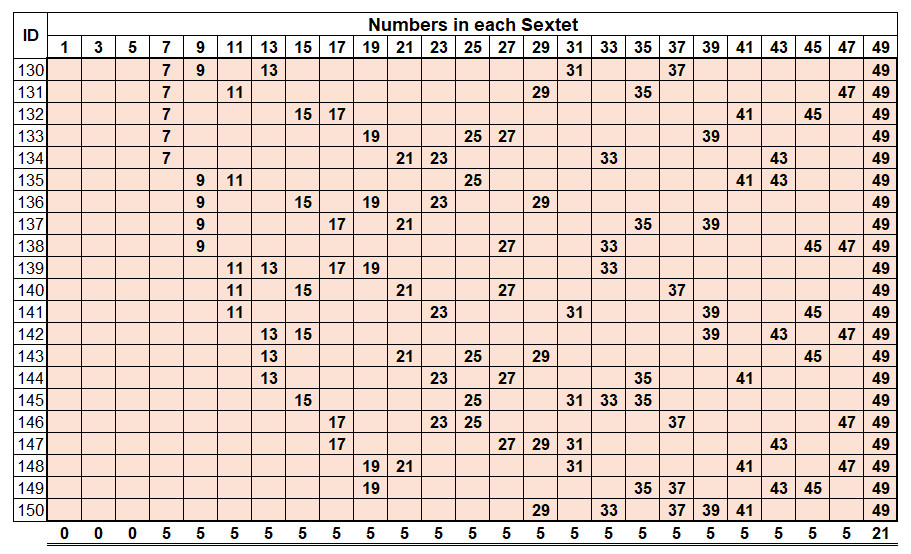
Take the 43-cohort and add 6 to each element, producing another 21 rows with IDs 130-150.
Odd numbers – special cases
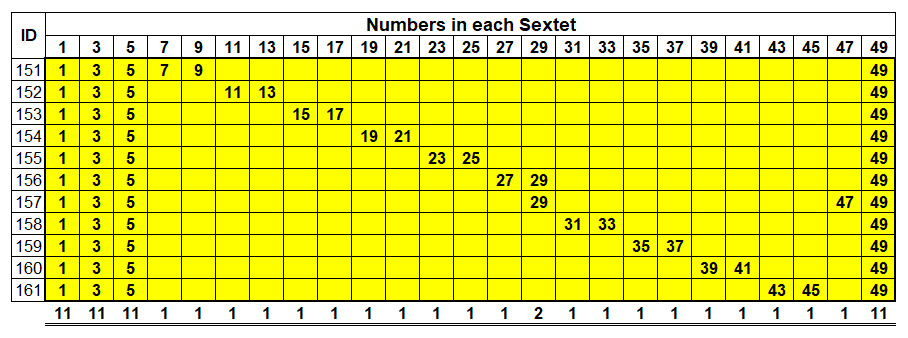
Now, all that is missing are rows (sextets) like {1, 3, 5, x, y, 49}, where x < y, 5 < x < 47 and 7 < y < 49.
Eleven more boards will suffice with IDs 151-161.
Conclusion
The Liverpool Hope mathematicians produced a list of 290 sextets (lottery boards) that, by adapting a Steiner system, guaranteed to win a minimum prize in the National Lottery online game known now as Lotto.
- 161 boards contained only odd numbers, while
- One hundred twenty-nine boards (129) contained only even numbers.
All 4,324 odd and even triplets were covered, some several times over, fulfilling the guarantee.
| Usage | No. of Triplets | Product | Examples |
|---|---|---|---|
| 0 | 14,100 | 14,100 | {1, 2, 3}, {47, 48, 49} |
| 1 | 3,080 | 3,080 | {1, 7, 11}, {2, 6, 10} |
| 2 | 1,106 | 2,212 | {1, 9, 11}, {2, 10, 12} |
| 3 | 124 | 372 | {3, 5, 7}, {4, 18, 20} |
| 4 | 2 | 8 | {9, 27, 33} – no even! |
| 5 | 0 | 0 | None |
| 6 | 0 | 0 | None |
| 7 | 0 | 0 | None |
| 8 | 0 | 0 | None |
| 9 | 0 | 0 | None |
| 10 | 6 | 60 | {1, 45, 47}, {2, 4, 46} |
| 11 | 5 | 55 | {1, 3, 45} – no even! |
| 12 | 0 | 0 | None |
| 13 | 1 | 13 | {1, 3, 5} – no even! |
| Total | 4,324 | 5,800 | |
| Grand Total | 18,424 | 19,900 |
The result was not a proper Steiner system, which introduced some redundancy.
Notes
- [1] This game was named Lotto in 2002 as part of a re-branding exercise fronted by the comedian Billy Connolly for the National Lottery.
- [2] If two triplets have no numbers in common, they build a sextet, which is a valid lottery board.
- [3] I am not a graduate mathematician, but I did study mathematics as a subsidiary of my chemistry degree. However, I know there is more to mathematics than arithmetic, geometry, trigonometry, and calculus, which I studied in high school and beyond. Professional mathematicians are obsessed with number theory, patterns, structures, and operations – the skills necessary to study the underlying theory of lotteries and more.
- [4] Steiner’s system has been refined to include parties bigger than pairs. i.e. t > 2.
- [5] R. T. Curtis, A new combinatorial approach to M24, Math. Proc. Cambridge Phil. Soc. 79 (1976) pp. 25-42.
Revision date: 22 October 2024